THE REALITY OF EXPERIENCE
Iñaki Domingo, Jorge Isla
DATES & LOCATION
September 2023 – March 2024
S Gallery Madrid
c/ Ferraz 78, 28008 Madrid
ABOUT THE EXHIBITION
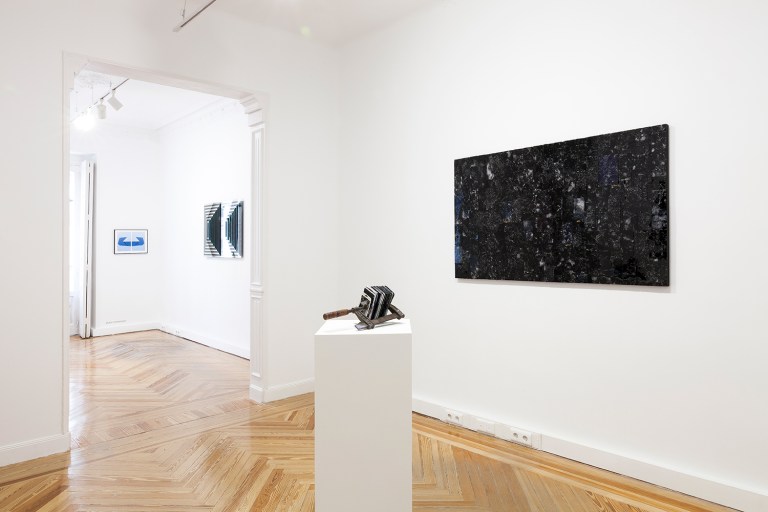
In The Reality of Experience, artists Iñaki Domingo and Jorge Isla explore the fragile, ever-shifting nature of images in the digital age. Through reflective surfaces, sculptural forms, and broken screens, they invite the viewer to engage with works that change depending on movement and perspective—highlighting the fleeting, personal, and political dimensions of seeing today.



FEATURED ARTWORKS

ABOUT THE ARTISTS
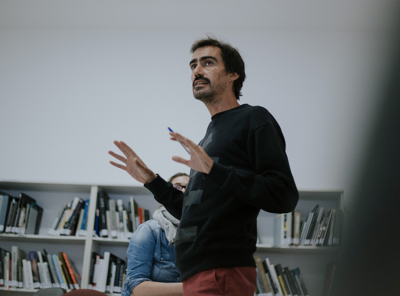
IÑAKI DOMINGO
Madrid-based artist working from an abstract perspective to explore the mechanisms of visual perception and the relationship between gaze and reality. Member of Altura Projects, he also collaborates independently on curatorial, editorial, and teaching projects.

JORGE ISLA
Explores the intersection of photography, sculpture, and video to reveal aspects of reality imperceptible to the human eye. His practice focuses on observing and analyzing contemporary modes of production and consumption.
CURATORS' COMMENTARY
"The Reality of Experience"
by Émilie Flory
Brussels-Paris, 2023
Both Iñaki Domingo and Jorge Isla come from the realm of imagery, and the works presented in dialogue for the first time in this exhibition take this background into account. In addition to their common interest in plastic forms and an evident correlation with abstract art, their respective investigations also address the question of photography and politics.
Iñaki Domingo develops an artistic practice that questions the image and photography in its broadest sense. He studies the sometimes contradictory links between the act of looking, perception, and representation. Jorge Isla’s work focuses on the complex relationships between modes of production and consumption in contemporary society. His sculptural, filmic, and photographic works adopt a critical and social view of the world.
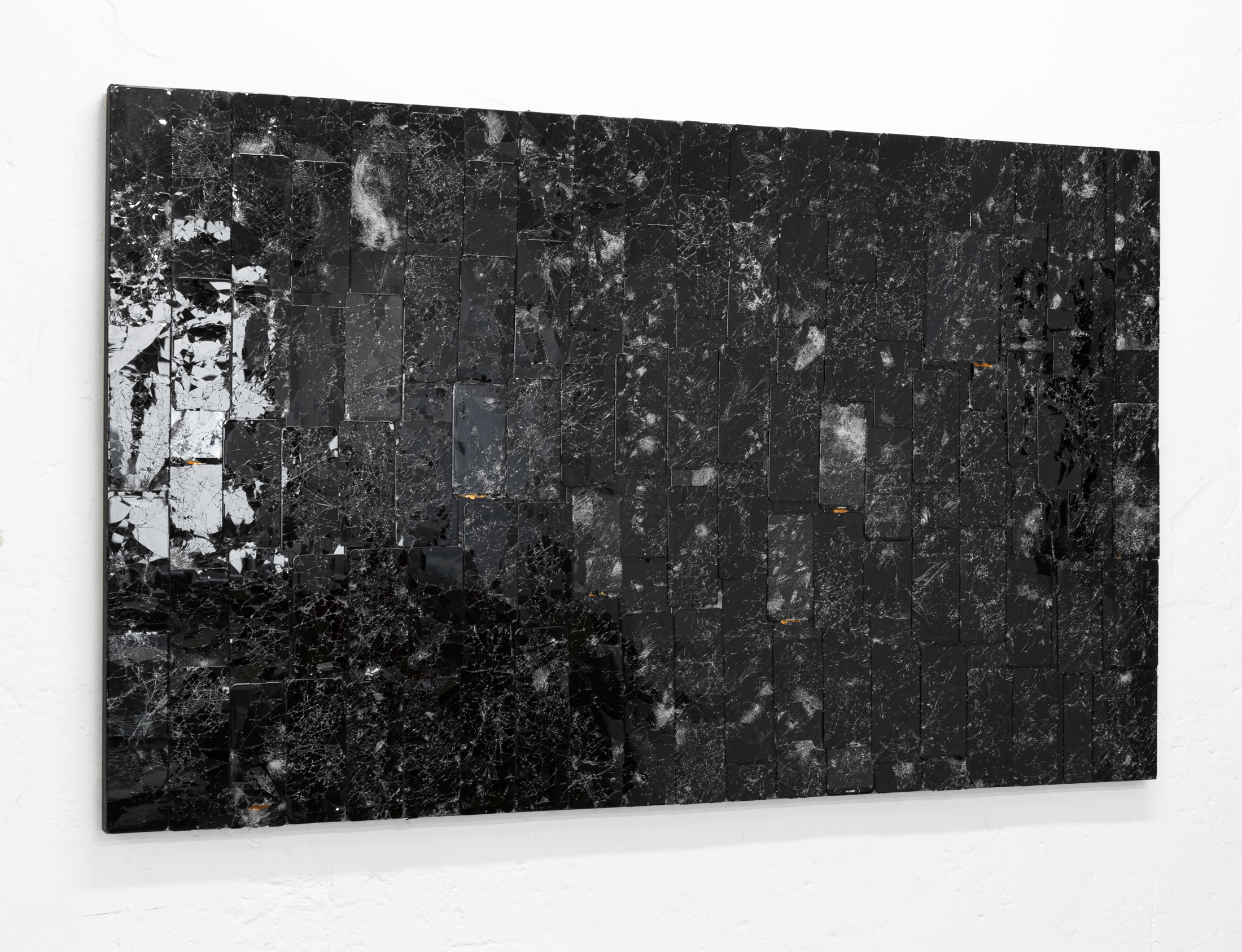
Have you ever experienced the sense of collapse that overwhelms the owner of a smartphone that has just broken? A shattered screen that will inevitably turn black with numerous new veins on its surface… Panic. Dread. Immobilization.
In a fraction of a second, everything in your body is destroyed! How can we live isolated from this new extension of the hand, from this object of reflection, from ours, from others, from which we nourish ourselves, from which it tells us where to go and how, what to look at and what to photograph?
“Waste disfigures food because it exceeds its function: it is what is not ingested; it is the food that takes away hunger.” 1 Waste is what has lost its function. Here, the state-of-the-art tablets and mobile phones that the artist uses to create his works are broken. The screens turned off are nothing more than fragmentary remnants of a “ça a été” memorial. The image is no longer there, but it wanders in our memories and imaginations.
Jorge Isla’s sculptures and installations recall modern vanities, with the highly plastic character of everyday objects assembled unnaturally to form a still life of science fiction. A kind of archaeology of the future, presented on a pedestal for the Still Life series or on the wall for Le Reflet.
The artist challenges us to think about what our gestures imply, and what the symbolism of this phone, smarter than a human being, takes beyond utility, becoming indispensable for those who want to believe in it.
Clearly, the black screens in Jorge Isla’s work have a boomerang effect on society, the proximity of science fiction, the black hole, and Black Mirror, which cannot reflect anything other than immense emptiness or the gateway to another dimension, a parallel life, Plato’s cave… It is also about illusion, or even the illusion of illusion, which we also find in Iñaki Domingo’s recent work.
I would like to talk about the Miroir noir, also known as Claude’s Mirror, in reference to Claude Gelée, known as Le Lorrain, who used a small convex mirror darkened with black smoke. It was an indispensable tool for artists and travelers in the 18th century in France and Britain, who turned their backs on the nature they wanted to capture on their canvases and used the black mirror for composition and its effects of light and color.
I find this human paradox in Jorge Isla’s committed works. Nowadays, referring to mobile phones and their black screens as the same accessory that allowed landscape painters to turn their backs on their subject… How can we not see in this distortion a metaphor for our contemporaries, who today can only look at the world through their mobile phone screens?
Here we are fully in the worship of the new sacred objects 3. And I can’t help but think of the difficulty I had the first time I had to step on Christian Marclay’s Footstep 4 work, like all music lovers and record collectors… and draw a parallel with Jorge Isla’s It is what it is, when visitors have no choice but to trample on the sacred object that covers the floor of the exhibition space. In the Blanco de España series, the artist had already confronted the viewer with the turned-off screen, that of shop windows turned white in Spain, shop windows for image projections without images, a place for all imaginations and projections.
The works of Jorge Isla and Iñaki Domingo are eminently generators of the imaginary, “(…) it is the imaginary that becomes a producer of systems to increase our understanding of reality, without being composed solely of what is proven: what is not yet proven can, or in any case could, exist.” 5 The image is omnipresent and absent, proliferates, is seen, but is not truly looked at. This is another point that unites the two artists: their tenuous connection to photography. The image, images, remain in Domingo and Isla’s work and research, and it is interesting to see how the works presented in conversation in the exhibition bring the viewer back to their contemporaneity and immediate existence, condemned to disappear… to the fleeting.
A fleeting and elusive image, the scourge of modern man: the Instagrammer! In Iñaki Domingo’s Mirrorworks, only the image that I can see will be captured. It will be different depending on whether I am tall or short, with precise acuity or with macula, whether I am presbyopic, a fighter pilot, or in a normative reality of size and ophthalmic capacity.
The image I see is created as I move, as I face the work from different angles, as I pay attention, as I contemplate. Moving and fleeting. Some would say magical, with the idea that the only image the eye can capture is the one that will not be visible to anyone else but me in a moment that can only be this one. Hic et nunc [here and now].
We can read in it a fantastic or religious version, like the connection with icons, with what is beyond us. But also a generosity, because this image will also live in the colors and shapes that surround it. What have images always produced but fascination and power play, illusions and beliefs, magic, finitude, and politics?
There is a sense of wonder in Iñaki Domingo’s work, which challenges the viewer and blurs our discernment. This was already present in the photographic series From Somewhere to Nowhere and had also appeared in his Color vaciado project. Here, the artist plays with perception. The works of Mirrorworks open up even more possibilities, as the image only exists at the moment the eye sees it, and the forms produced by the artist go beyond the photographic field. They are clearly related to abstract and kinetic art. How can we not find in them the idea of John Tremblay’s reality, Philippe Decrauzat’s optical interpretations, or Antonia Lambelé’s play of light?
I quite like that the artist diverts us (the viewer) and takes us from the notion of the intangible to the fragility of our humanity. His works subtly point out the ephemeral nature of what is seen and carry a certain melancholic poetry.
Of course, and it would be an aberration not to mention it, the reflection and the lost image, which appears and disappears depending on the viewer’s movement, are another common thread between the two artists. The works and statements of Domingo and Isla are complementary. Here, their dialogue accentuates the fact that each work offers a unique reflection to the viewer facing it, passing by, looking at it from an angle, and playing with the arrangement devised by the artists. An essential mirage.
Of course – and it would be an aberration not to mention it – the reflection and the lost image, which appear and disappear depending on the viewer’s movement, are another common thread between the two artists. The works and statements of Domingo and Isla are complementary. Here, their dialogue accentuates the fact that each work offers a unique reflection to the viewer facing it, passing by, looking at it from an angle, and playing with the arrangement devised by the artists. An essential mirage.
Marcel Duchamp’s words – “the viewer makes the work of art” – have never been truer, and to conclude, I would also add those of Clement Greenberg: “the only criterion is the reality of our experience.”
ARTIST'S COMMENTARY
"Significantes Significados"
by Iñaki Domingo
“Significantes significados” is a series of sculptures that I have been working on since 2020. In it, I use language, words, and basic design rules applied to text legibility as the main material to develop the works that make up this series. Through a system of rules, which I have specifically created for this series, I transform words into sculptural objects, which allows me to trace a path that moves from the idea (the word as a concept, meaning) to the form (the signifier attached to this idea, which defines the morphology of the word, and therefore, of the final object) automatically, without making any personal decisions regarding the appearance that the sculptures will have. Under this circumstance, the final form of the works is determined by the choice of each word and how it results in an object after being subjected to the rule system created for this purpose. The rule system created is based on the intentional distortion of the basic design rules applied to text legibility. The method I have followed to develop it is as follows: first, I select four-letter words and force inter-letter spacing to bring all the letters that form the word to the same axis, resulting in illegibility; then, I give them volume (extrusion) by making the base of each letter’s stem square-shaped; finally, I rotate each of the letters at different angles (each one has 45º more than the previous one), until the final object is formed, which is determined by the selected word after being subjected to these rules. The final object is created with the help of a 3D design technician, and subsequently, the sculptures are sent to be printed at one of the world’s most prestigious 3D printing companies, Materialise, located in Leuven (Belgium), to be printed using SLS PA12 technology, and later polished and painted in matte black with the latest technology in 3D finishing. The first work in the series, which starts from the Latin word HOMO, was produced thanks to a commissioned order from a private company. In this work, I also included an electromagnetic system that makes the piece levitate and rotate on its base since the intention was to “elevate” the chosen term with an unstable fragility.