IN THE OPEN SILENCE
Carlos Blanco Artero
DATES & LOCATION
September 2024 – March 2025
S Gallery Madrid
c/ Ferraz 78, 28008 Madrid
ABOUT THE EXHIBITION
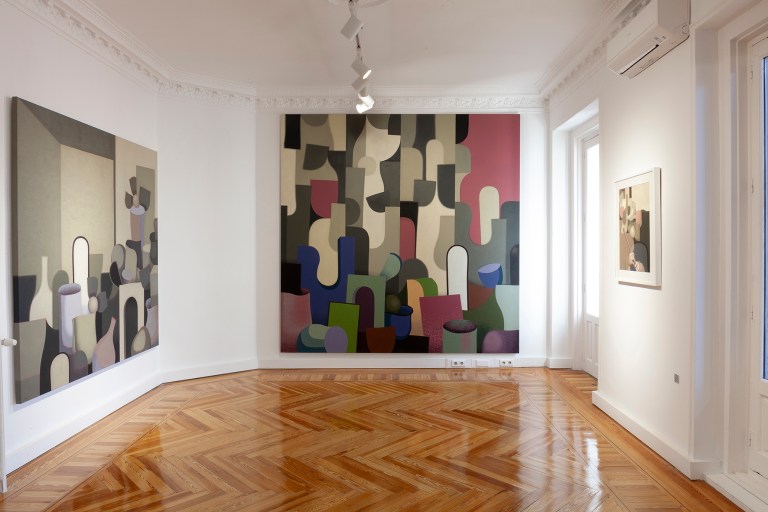
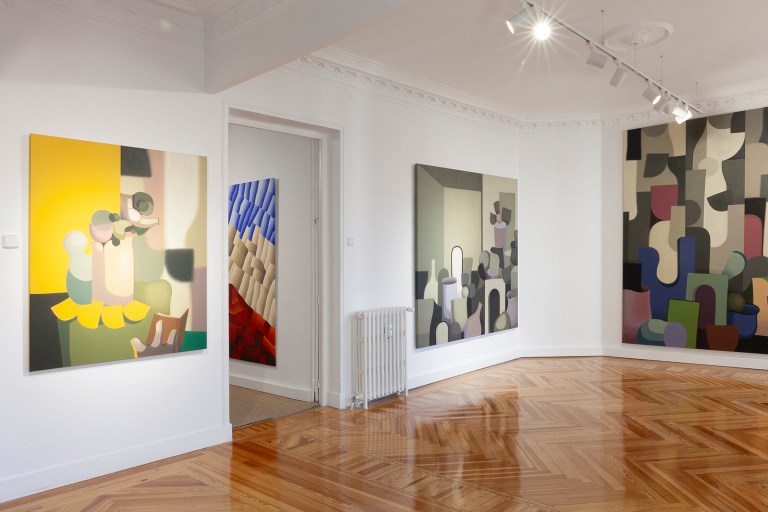
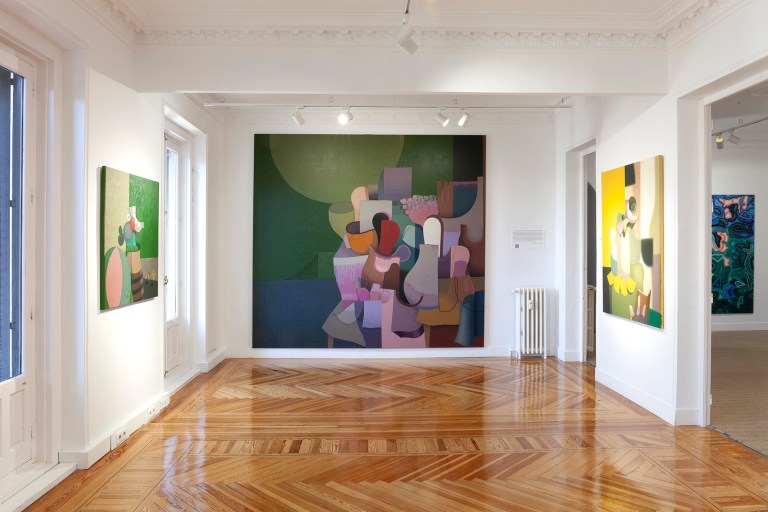
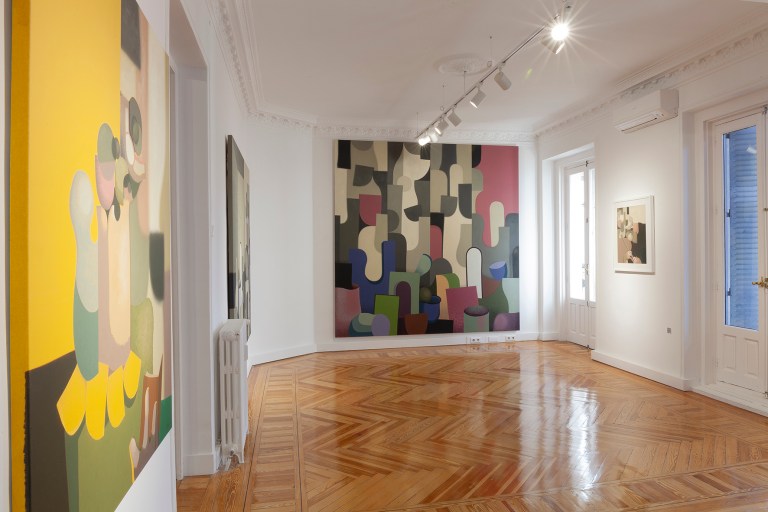
Carlos Blanco Artero approaches painting as a space for introspection and rupture, where abstraction meets figuration in a language shaped by silence and complexity.
His compositions unfold like mirrored landscapes of the psyche—fragments of a visible world shifting toward the intimate. Influenced by imaginal traditions, his work suspends meaning to evoke what lies just beyond perception: the desire to see what cannot be fully seen.

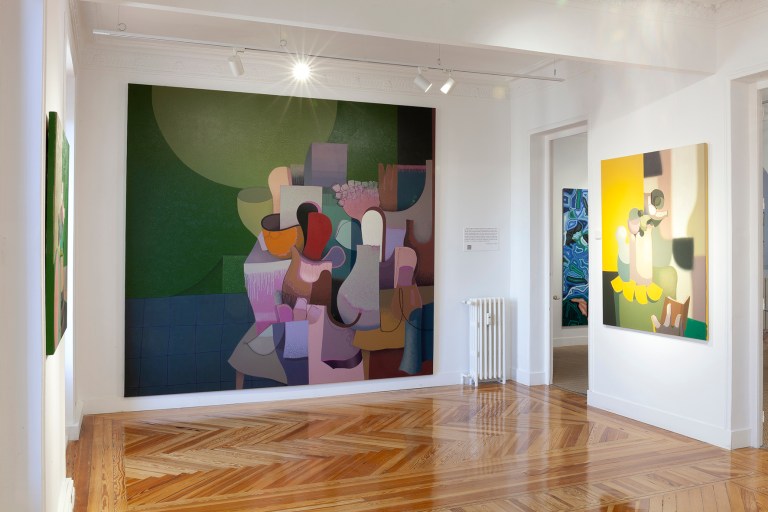
FEATURED ARTWORKS


ABOUT THE ARTIST
CARLOS BLANCO ARTERO
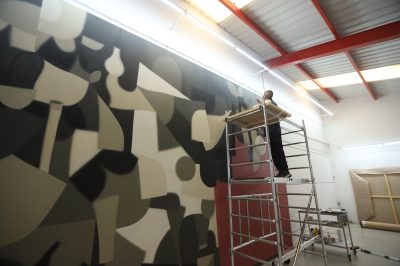
Carlos Blanco blends figuration and abstraction to explore identity and perception. Influenced by cities like Berlin and New York, and artists such as Picabia and Condo, his expressive, fragmented works challenge visual conventions and appear in collections worldwide.
CURATORS' COMMENTARY
Carlos Blanco Artero, In the Open Silence
by Alfonso de la Torre
2024
Seeing the latest paintings of Carlos Blanco Artero (Madrid, 1983), I thought of Paul Klee’s celebratory exclamation in the port of Tunis: “I am a painter.” Like him, the painter from Bern was also a musician, which made me recall Kandinsky in his reverie, also sharing the passion for Debussy’s spiritual impressions. At the same time, I recalled Klee’s painting at the Metropolitan Museum, a beloved museum for our painter: “Temple Gardens” (1920), a pictorial territory of potent and strange forms that I see in proximity to certain works of Blanco Artero, especially in their mysterious essence and the necessary search for expression with new symbols, remembering that “certain things can happen under our feet, there are regions where other laws are in force, for which it would be necessary to find new symbols (…) the intermediate realm of the atmosphere where its heavier brother, water, shakes hands with us and intermingles so that we can then reach the great cosmic space.”
Blanco Artero appears to be an artist bearing a Duchampian open silence; his paintings could relate to certain canvases of Marcel Duchamp such as “Portrait of Chess Players” or “Young Man Sad in a Train” (1911), as well as with the duo “Nude Descending a Staircase” (1911-1912) or “Bride” (1912). Like Duchamp, he is a refined and intelligent reader of art history that preceded him, also capable of setting it aside. Blanco Artero can fragment images into moments, making his paintings true mirror games of reality, as, after approaching reality, these works seem to shift toward intimacy, tempting the expression of a certain internalization of what is painted, resonating in such a way that something timeless roams within us. His painting is a slow revelation, manifesting a language of poetic essence that allows him to construct a web of individual resistance, which becomes a world of distinct aesthetics. Blanco Artero is a true painter’s painter, a visionary interpreter of the history of contemporary art, which he observes and shows as a partition of voices, while also embodying a lucid and constant state of alertness. For him, painting, he will say, “is not a weekend job but rather occupies all my time; therefore, the artist’s experience and the maturity of their work must be associated.”
In this aesthetics of visibility, in such a radiance of painting, mystery unfolds, those Klee-like atmospheres, one of whose reserves is the attempt at three-dimensionality. His space is populated by an intensity and energy that retain a theatrical air that has sometimes reminded me of certain low lights of Giorgio de Chirico, especially in the wisdom with which Blanco Artero fictionalizes shadows that thus seem to transfigure a mysterious space where nothing is what it seems and the narratives, in this way, multiply ad infinitum, Marcel again. Like someone who decides to represent the longing of waiting images, his painting expresses the desire for introspection within space, knowing the spell that certain images can operate on our thoughts. His attempt to make the invisible visible is a rehearsal for another dimension of space in his painting, moving us toward the clear nakedness of silence. Thus, these images keep their interpretation or significance held and in suspense, like a collision where thought remains open. An abstraction sustained by the power of images that seem to emerge from the development of a true inner polyphony, images that are resolved into abstract worlds, his being a world of extraordinary complexity under firm imaginal expression, where he has habitually reclaimed artists like Georges Condo and Francis Picabia. One might also think that his canvases would be a good context to integrate the imagery of David Smith’s world or the games of differences and trompe l’oeil of Vik Muniz, or connect some of his cycles with the mirror landscapes of the evanescent Maria Helena Vieira da Silva.
His painting could have visited that mythical “L’art cubiste” (1929) by Guillaume Janneau, encountering those Metzinger and Lhote, as his pictorial work connects with a certain Cubist tradition and, in general, with the aesthetic experience of modernity, which he had the opportunity to contemplate during his stay in Paris between 2007 and 2008. But his painting exceeds the Cubist experience by addressing certain games of painted superpositions, like collaged images to which he gives – in the back-and-forth between focus and blur, obvious images, or others bearing an aura – a resonant voice traveling between display and silence, like someone who, in his painting, might establish true meditations in images. Painting as a form of access to himself, addressing a formal representation that can be totalizing yet also fragmentary, sometimes fractal or with eclipses. The expression of latent systems also explains cycles of works in which, like those Books of Hours, from the same composition, the play of differences is rehearsed, which reminded me of Foucault’s “one speaks through difference.” These works would have deserved incorporation into that mythical exhibition “Repetitive Structures,” which reflected on a line of creation that shifts from Cézanne and the visions of Mont Sainte-Victoire to Analytical Cubism, from Neoplasticism to Paul Klee, or from him to Lucio Fontana.
It must be considered that Carlos Blanco engages in a perpetual passage of reflections in multiple directions in a journey that does not cease, being capable of unfolding freely, finding in his works painting, drawing, and sculpture, or, uninhibited, what is expressed in muteness, abstraction and figuration, fullness alongside emptiness, precision in proximity to what seems to fade. Something that seems to slide from his admiration for Condo’s work: “the materialization of an idea that had been lingering in my head for years: a painting that could contain everything, drawing and painting, figuration and abstraction, which would shift his work towards a completely different panorama.” In this way, rather than witnessing his paintings in stillness, they appear before us removed from the passing of time. He has referred to the “Cubist pseudo-perception” on the occasion of one of his latest major works, the reinterpretation in triptych of the monumental “Guernica” (1937) by Picasso, commissioned by the MNCARS in 2023, as an act of extraordinary complexity, both physical and intellectual, also courage, facing a bewitched and painful painting that he admired and drew since his childhood.
A practitioner and advocate of vital nomadism, this has not prevented him from having a strong attachment and the influence of the spaces where he worked, places and life situations that, at every moment, occurred. I recalled those words of Michel Peppiatt about Giacometti’s studio: “the studio becomes the artist’s vital refuge, an irreplaceable space with which they establish a strong and intricate relationship through the bond with the work initiated, abandoned, or completed over the years. This generally applies to most artists.” Bearing a quiet voice, as an artist, however, he is an absolute narrator, as observing his various cycles or series [“Neofiguration” (2003); “Arabesque” (2015); “Iptics” (2015); “Crowds” (2016-2017); or “Fiesta” (2021)], in any pictorial moment, his paintings evolve with delicate and continuous transformations, true through-painting populated by infinite games of continuously renewed similarities that can be traversed in one direction or another, from today to yesterday or early-seen canvases find us with the now, without hierarchy, endless cycles like an affirmation of how the exercise carried out by Blanco Artero can be understood as autotelic, a reflection on his own painting as a self-reflection, the exercise of being his own model.
Ceremonial of the imaginary, spacing of clarity, thus his paintings seem to extend like a game of transfers between one painting and another, translations sometimes of small differences into small differences. Think of his “Iptics” cycle (2015), thus addressing common formal obsessions that Blanco Artero places as temporal incidences of serene agitation, exercising that vindication of “keep in view the multiplicity of language games” in Wittgenstein’s words. Infinite suspended finite, after all, life is made of light and shadow, perhaps for this reason, in his work, the essential depends on a detail, like slight disorders of situations, of shadows and objects represented in the fiction of his reality, like that treatise on wandering shadows by Pascal Quignard, for “between images and nothingness there is a precipice. There is only a footbridge that allows one to cross it.” And thus, contemplating his work places us before the fascination exerted by mystery, the questions harbored in the unknown space mediating between the visible and the invisible, his attempt at decipherment while, in transit, the illusion of a shift toward the one who, having become mute, contemplates.
In 2024, a sculpture reminded me of Brancusi, an endless column now possessed by lightness and a delicate color, titled “Spring.” It carries something of that attempt at three-dimensionality in his paintings I wrote about, of the necessary journey of the forms of his paintings, as if they had descended to the ground and were now like a merzbau of colorful objects elevated into space, a flower exhaling its forms into the sky, knowing that everything in the world is a mirror, a secret reflection of the universe.
As in that poem by Octavio Paz about Motherwell, the appearance takes place after the hand-to-hand, the idea made act. Painting as an exercise of rupture and advent, ways of thinking about painting, Carlos Blanco becomes a seeker of a strange space of questions to come, as if painting in a state of shock; his is a restlessness that seems to suggest that painting is not so much a port to arrive at but rather a true unlimitedness, a distance never satisfied.