ANOTHER WAY OF LOOKING
Carlos Blanco Artero
DATES & LOCATION
September 2023 – March 2024
S Gallery Madrid
c/ Ferraz 78, 28008 Madrid
ABOUT THE EXHIBITION
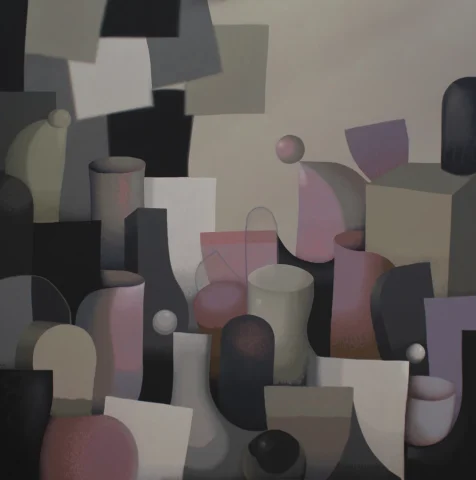
Carlos Blanco Artero’s work invites the viewer into a state of perceptual tension, where abstraction and figuration dissolve into a playful, vitalist choreography of color and form.
Drawing from a wide range of influences —from Picabia and Bacon to Mondrian and Vieira da Silva— his painting is not a static image, but a dynamic field where rhythm, sensuality, and the unconscious converge. With a technique that merges lucidity and disruption, Blanco Artero constructs pictorial spaces that seem to pulse from within, offering not answers, but new ways of seeing.
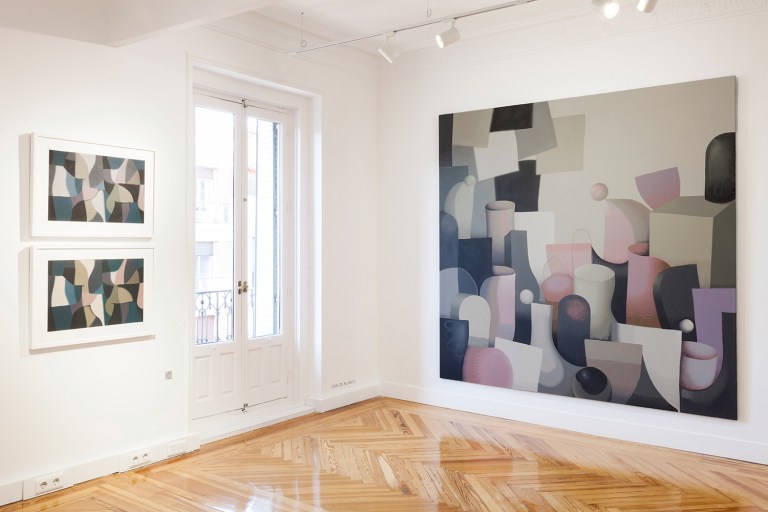
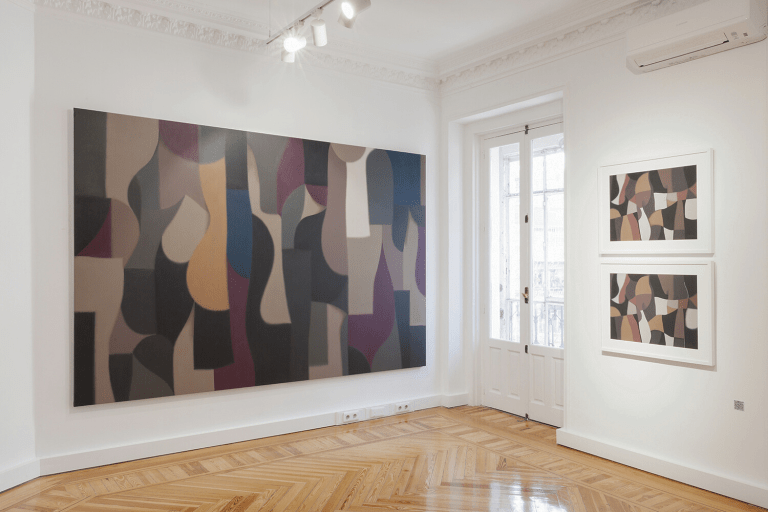
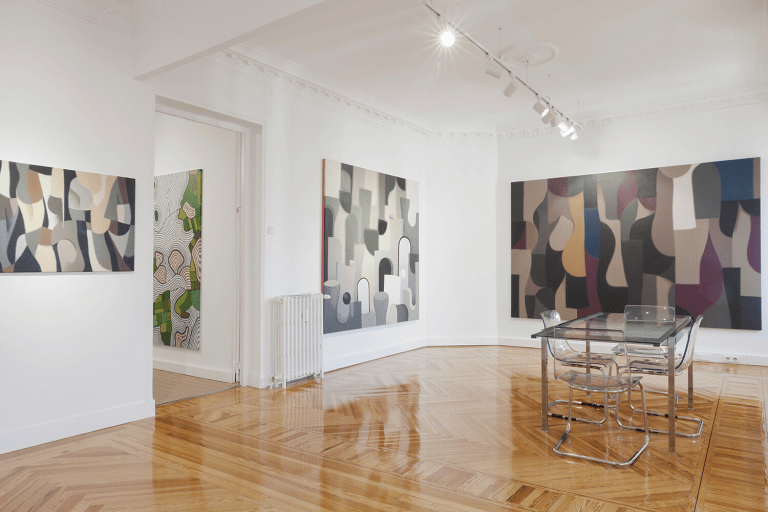
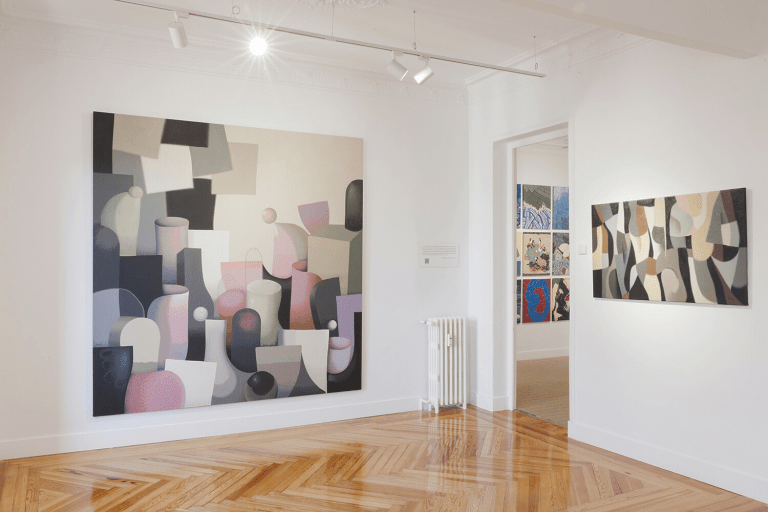
FEATURED ARTWORKS
ABOUT THE ARTIST
CARLOS BLANCO ARTERO
Carlos Blanco blends figuration and abstraction to explore identity and perception. Influenced by cities like Berlin and New York, and artists such as Picabia and Condo, his expressive, fragmented works challenge visual conventions and appear in collections worldwide.
CURATORS' COMMENTARY
Another way of seeing
by Fernando Castro Flórez
2023
Leonardo da Vinci noted that painting is not alive in itself, “but without having life, it gives expression to living objects” (Treatise on Painting, paragraph 372). It is about presenting before the eyes, evoking in its plasticity a dynamic of the living. Unlike language, the image has the capacity to seemingly perpetuate movement and, with it, keep the bodies represented by it “alive”. “This conclusion is based,” warns Hors Bredekamp in his Theory of the Iconic Act, “on the fact that, at the mathematical point that defines the passage from nothing to the line and that produces with its movement the construction of the painting, inaction and succession, the immaterial and the material are united. The immaterial point is, as the foundation of painting, the element of a permanent transgression that leads beyond itself towards its opposite, offering in this dynamic the basis of that captivating quality that captures the observer.
It is demanding, because, coming from nothing, it fills the infinite as the opposite pole and from there draws its inexhaustible liveliness.” Carlos Blanco Artero’s painting is undoubtedly marked by intense vitalism in a fascinating play of forms that sets the viewer’s imagination in motion. Carlos Blanco Artero has acknowledged that his aesthetic is influenced by artists such as Picabia, Richter, Bacon, or Saura, making figuration and abstraction dialogue extraordinarily, picking up the inheritance of both cubism and abstract expressionism. Far from an orthodox codification of “modern tradition,” he manages to articulate his own approach with exquisite pictorial technique and a great capacity to modulate themes that mainly allude to desire, bodily passion, or the seduction produced by women. If in a work like Zumbao (2021) a schematized or grotesque face with “dislocated” teeth and a single “unhinged” eye is easily recognizable, in an earlier work Violinist (2015) the trace of the musical instrument is unrecognizable and what we see are curved forms that have something of an “unsolved puzzle”. A playful tone, a kind of “comedy of art,” enlivens this imaginary in which a Gogo (2021) may appear dancing on a cylindrical podium with heels that put her body on the brink of a precipitous fall or it can also become the protagonist a drunk German in a painting from 2020 in which the elements of the face are disheveled.
We cannot forget the importance, in a general sense, of abstraction in the twentieth century. “Painting,” points out W.J.T. Mitchell, “has always been the fetish medium of art history, as poetry has been of literary history and cinema of media studies. And modern abstract painting has been the fetish object of painting history, the specific style, genre, or tradition (the difficulty of naming it is part of the question) in which painting is supposed to find its essential nature.
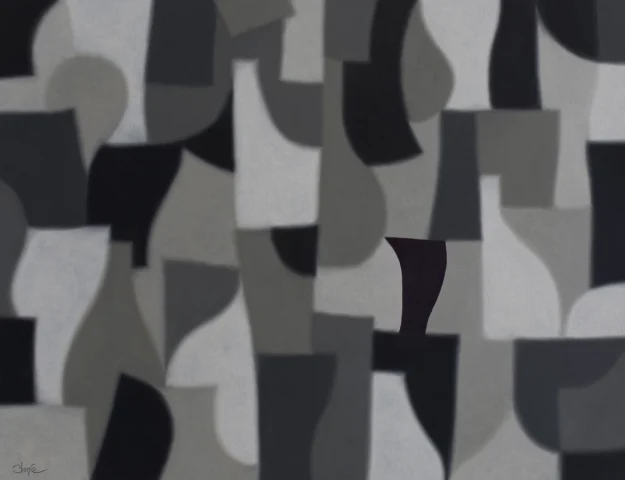
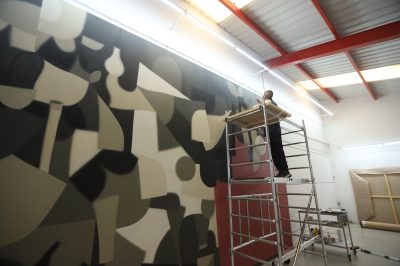
Clement Greenberg expressed it more eloquently when he stated that the abstract artist is so “absorbed in the problems of his medium” that he excludes any other consideration.” In Carlos Blanco Artero’s trajectory, some of his most accomplished works complete the abstract dynamic, as exemplified in Checkmate (2023), a large-format painting (235×235 cm.) that obviously alludes to the game of chess, but in which we do not need to “identify” the pieces or the board. Regarding the inextricable constitution of the weave in painting, Yves-Alain Bois recalled the “braided labyrinths” of Mondrian’s collages.
The becoming-visible of the pictorial-place manifests something like the effectiveness of its reverse or rather, the interlacing produces a lability of the planes. Carlos Blanco Artero assumes the modernist flatness of painting and, at the same time, introduces a sensation of mysterious spatiality, a sense of internal movement in the painting or, even synesthetically, we can speak of musicality. It is not accidental that this artist enjoys interpreting pieces by Debussy that he sets to dialogue with his pictorial passions. Carlos Blanco Artero has perfectly understood the (chromatic) qualities of the sensitive material of painting. His is one of the most lucid paintings that can be found, although they do not exclude “torn consciousness”, always thinking about the constitution of the visible as the advent of color, as a matter that is, paradoxically, as dense as it is subtle.
We would have to rethink color, in Aristotelian terms, as potency (vehicle of visibility) that exists on the limit of bodies. Chromatic impulses are complex, although, in the case of this painter, we notice an impressive ability to combine colors in sensual rhythms without stridency, avoiding the routine of monochromaticism and without falling into stridency either. Undoubtedly, we must claim, in front of such a mature and intense aesthetic, the word voluptuousness, transforming “checkmate” into a game that, joyfully, never ends. In the painting in which he captures Isa (2019) the metamorphic dynamics of ‘facedness’, in the Deleuzian sense, focuses on an eye that is almost “hyperrealistic”.
Affections and desire weave this playful way of pictorial proceeding in which figuration and abstraction are not antagonistic, leaving aside any anecdotal approach. Flaubert said that the first purpose of art was to make you see (faire voir) and then make you dream (faire rêver); the author of Elective Affinities confided to the Goncourt that when he wrote a novel, the plot was less important than the desire to give it color, a tone. The painter -Merleau-Ponty stated categorically- whoever he is, while painting practices a magical theory of vision: things go directly to the spirit and it comes out through the eyes to go for a walk in the concrete. The praise of the visible seems to challenge all those who claim to enclose the world with words. Painting bodily opens the world, makes us, in every sense, seers. Carlos Blanco Artero shows a quasi-cubist “checkmate” in which, to parody Picasso’s formula, he finds what he seeks: the white, gray, or black chromatic planes play with cylindrical or spherical forms, leading us through the surface to feel a sensual topography. In Checkmate, which recalls those surreal landscapes of Yves Tanguy and also refers to the festive conception of painting by Francis Picabia, a wide “zone” (in the upper right part) apparently empty is maintained, although we can suggest that it is occupied or traversed by our gaze. Perhaps we have to contemplate the paintings of this passionate painter not so much looking for a meaning as enjoying a playful impulse, without fear of losing face, looking for another way of seeing.