DISAPPEARANCE AS MEMORY
Víctor Manzanal
DATES & LOCATION
February 2024 – September 2024
S Gallery Madrid
c/ Ferraz 78, 28008 Madrid
ABOUT THE EXHIBITION
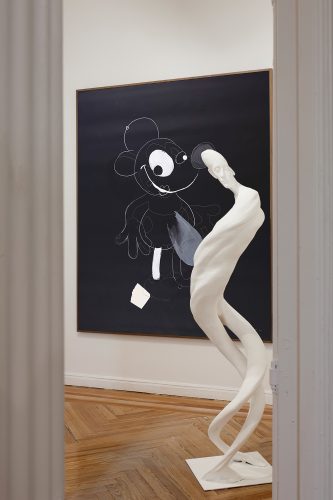
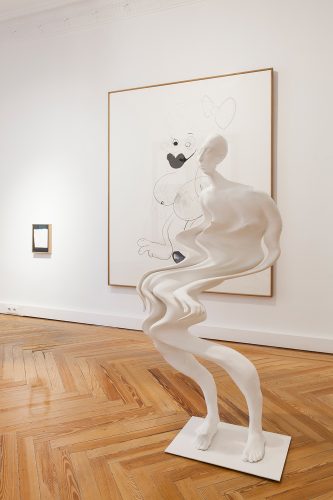
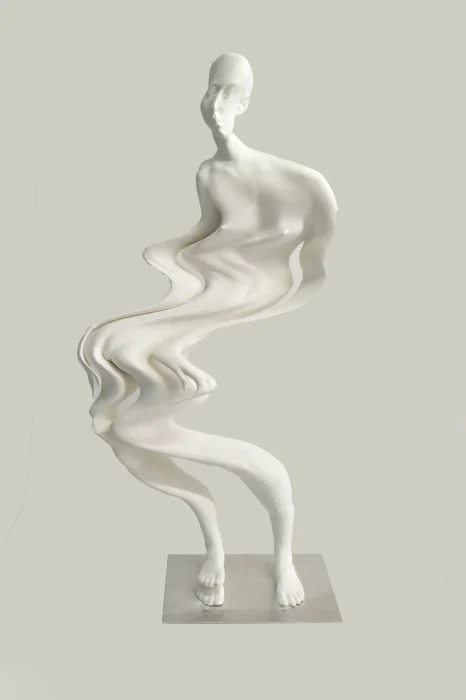
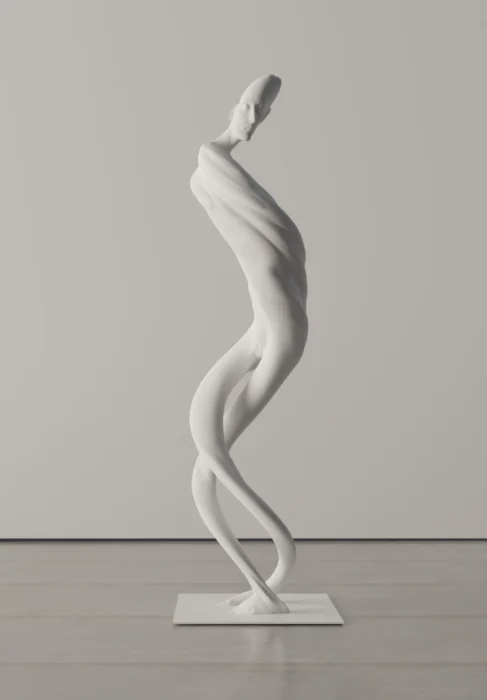
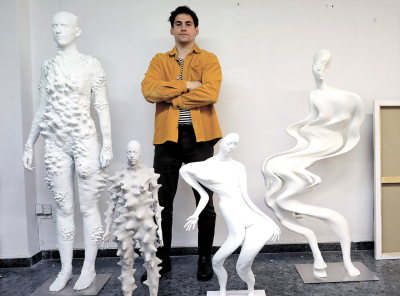
Víctor Manzanal’s sculptures trace the fragile boundary between presence and erasure. Rendered through digital modeling and materialized in resin, his figures seem to appear and vanish at once—bodies in mid-disintegration, shaped by time and entropy. Each piece feels like an imprint of something that once was: a visual residue of change, memory, and transformation.
Informed by dystopian visions and organic processes, his works are less objects than energetic events—moments suspended between becoming and fading. They invite us to consider disappearance not as loss, but as a form of transcendence.





FEATURED ARTWORKS
ABOUT THE ARTIST
VÍCTOR MANZANAL
Navarre-born sculptor whose work explores the boundaries of human nature with the animal, vegetal, and inanimate. Using organic materials, he investigates processes like fossilization and petrification, creating symbolic works that reflect on identity, memory, and persistence.
GO TO ARTIST PROFILE ⮕
CURATORS' COMMENTARY
by Óscar Manrique Ares
Víctor Manzanal is one of those artists who shares a worldview not far from the new dystopias seen in movies and fiction novels of recent decades. These dystopias depart from the utopian futures of the mid-20th century, in which we evolved as a society, to show us endings not so attractive for the species. In the work of this artist, the exploration of human destiny is manifested through a duality that may be as old as the origins of our world. On one hand, in some of his works, we observe a connection with the nature that surrounds us, taking us back to a primordial state where the individual dissolves into mineral or organic formations, becoming the essence or sustenance of a much larger and unlimited natural growth process. On the other hand, he addresses the unsettling disappearance of humanity, a loss that formally resembles the glitches of digital screens in our era, where the body distorts and dematerializes, becoming a “non-body” that leads to the loss of identity, the great fear of our century.
But what Victor Manzanal’s sculptures always bring to the stage is time. The same time that Beckett articulated most precisely when he wrote “everything ceases, incessantly,” another way of studying that tension that consists of the fundamental relationship between ending and duration that we see in Manzanal’s work. A time of knowledge that formally also becomes discontinuous, unstable, intuitive, intermittent, and even faint images, as they are “shaped” over the singular time of appearance.
Those bodies that disappear contorting upon themselves seem to do so “suddenly,” a way of indicating the extraordinarily brief duration that is sensed in the narration, in the singular—visual and temporal—of its appearance. Sculpture is a process; they are not simply static objects but dynamic processes of “pure energy.” The form of these sculptures precisely implies the dissipation or transformation of that condensed energy, resulting in figures that we perceive as having limited duration. But what disappears suddenly also does so singularly, irretrievably, and therefore, it carries strangeness, its remnant image will not disappear so easily. Like a visual double, his works leave a wake, the idea of disappearance itself necessarily carries a previous existence; for no one disappears from the face of the earth without a process of change, it needs seconds—the ones captured in his work— even for its disintegration.
The essence of his work is change, that movement that places or, rather, perceives as reality itself, seeing only in the immobility of the sculpture an abstract, instantaneous moment that appears and disappears almost immediately in the opaque sky of human intelligence. Thus, we can say that his sculptures are matter, but also memory, as they disappear in their stability, in the nature of the “immovable cut” of the discipline itself, which suggests a continuous duration that, in a way, will form the shifting medium of appearance. His investigations are in a kind of coming and going in the act of creating the image, between the intensio — tension, silent evocation, which is also an invocation and even a convocation — and the revocatio or process of its own disappearance. This duality between appearing and disappearing is reversed in the new means of conceiving the discipline, from which Victor takes advantage to carry out his work, starting with a virtual 3D modeling, an immaterial medium that later materializes in resin in a relatively short period of time; they appear out of nowhere to disappear in their forms of existence.
His work seems to give in advance all the answers to a future space and time, and although the formal hindrance is omnipresent, the disappearance of the human is also fear; therefore, the destiny is not closed on the schematic of his figures. Just as the disappearance of his bodies is intuitive, the expansion follows an organic growth marked by those vegetal or mineral patterns, it is a scientific but also intuitive growth, at least for the human mind. The order of space and time is inserted into Victor’s sculptural language as a mythological natural power that acts in the context in which it intervenes, invading everything.
Manzanal’s sculpture is not defined solely by the poetic nature of its content, but by its form, that is, by its “internal tension,” the life impulse that makes them mutate or the forces that mobilize to open holes in which they disappear. In this sense, the sculptures are not objects but a process; the temporal consequence of this status of “pure energy” emitted by the pieces would be that the images presented to us never last long, as their form implicitly implies the disappearance or transformation of their condensed energy. Both paths lead to a death that, in the artist’s words, does not represent destruction, but transcendence, a search for comfort and meaning. In fact, as philosopher Hannah Arendt mentions in her famous essay “The Human Condition,” men, though destined to die, were not born for that purpose, but to begin. I suspect that this desire to escape from the current human condition also underscores the hope of prolonging our reality beyond what a discouraging future holds for us. The only uncertainty that remains before any kind of artistic manifestation is that not even painters, not even musicians, are sure to have succeeded in creating an image that is stillness.
Victor Manzanal manages to connect with our society and the environment where his works have been created, generating genuine agitation in the most perspicacious and attentive spirits. In this way, they immerse themselves in the convulsive beauty that André Breton defended in his manifestos, that which, through calculated aesthetic violence, is capable of subverting the state of things. Thus emerges a peculiar symbiosis between art and life, between intangible but perceived presence, as they must be understood as images in terms of energy and intensity. Beings that seem to be possessed by a rebellion against human existence as we know it, a rebellion that represents that higher life drive or, conversely, lends itself to an erasure that will only leave a wake in virtual memory.