THE EVERYDAY, ELEVATED THROUGH FORM
Rómulo Celdrán
DATES & LOCATION
September 2025 – March 2026
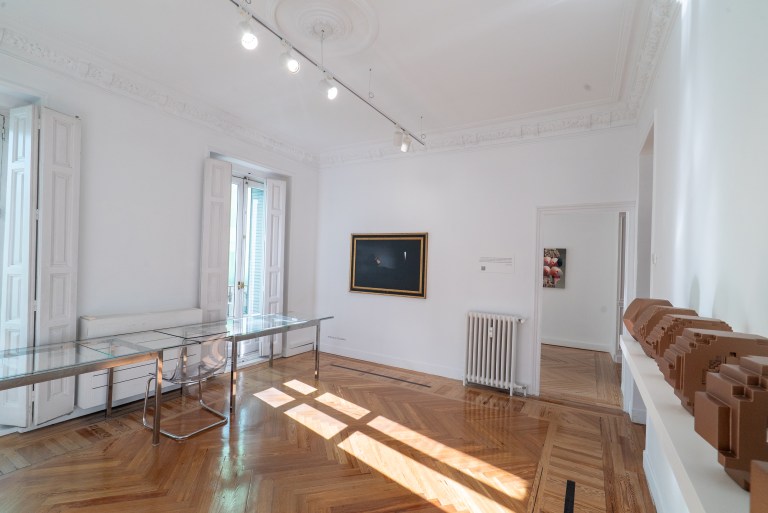
S Gallery Madrid
c/ Ferraz 78, 28008 Madrid
ABOUT THE EXHIBITION
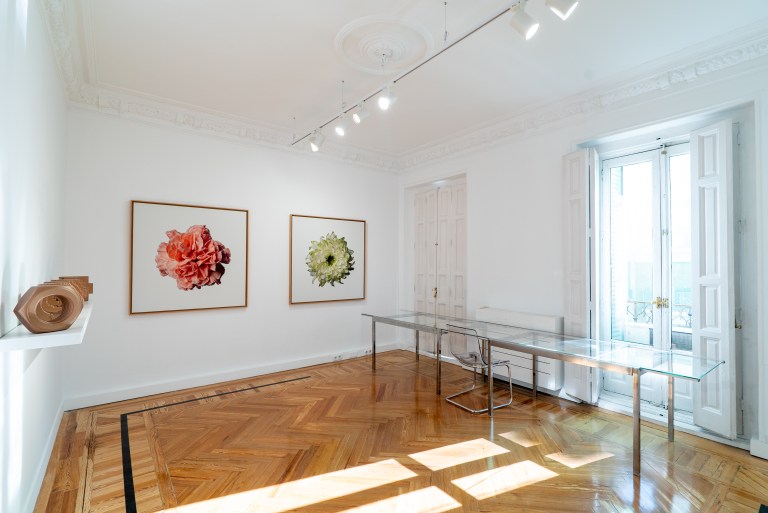
Rómulo Celdrán transforms ordinary objects into poetic reflections on perception. Blossoming celebrates the structural beauty of flowers beyond decoration, while Digital Tenebrism reimagines Baroque light through today’s digital glow. Both series explore the tension between nature and technology, inviting us to see the familiar with new eyes.
FEATURED ARTWORKS


ABOUT THE ARTIST
RÓMULO CELDRÁN
Rómulo Celdrán crafts hyperrealist works that magnify and decontextualize everyday objects. With references from Flemish masters to Pop art, his pieces blend classical technique with reflections on digital culture and perception.
CURATORS' COMMENTARY
by Luis Martín
Madrid, 2025
“Seeing comes before words. The child looks and recognizes before it can speak. But seeing is also a choice, because we never look at just one thing; we are always looking at the relation between things and ourselves.”
John Berger, Ways of Seeing, 1972
When we encounter a work by Rómulo Celdrán (Las Palmas de Gran Canaria, 1973), our senses seem to sharpen. We attempt to decipher what is presented to us, to understand its nature, until what initially appeared to be a straightforward representation of something familiar transforms into an experience that delves into the unknown, rooting itself deep within our perception. His work invites us to look beyond the obvious, where the artist’s technical virtuosity becomes a key that unlocks new spaces for reflection on how we conceive our reality.
Celdrán’s work is characterized by its ability to decontextualize objects and everyday scenes, transporting them into a realm where their formal representation—through line, volume, texture, and light—prompts us to reconsider their meaning and aesthetic value. Unlike other conceptual artists, Celdrán places a strong emphasis on traditional artistic techniques, meticulously recreating the intrinsic qualities of what he represents. This approach elevates the subject matter, questioning what turns an ordinary object into art and what perceptual processes influence the construction of its value.
Throughout his career, the artist has explored both painting and sculpture, a testament to his ongoing experimentation and plastic research. On this occasion, we are presented with two of his most recent pictorial series: Blossoming and Digital Tenebrism. Although they explore different territories, both share the intention of prompting reflection on our perceptual processes and heightening our awareness of the everyday.
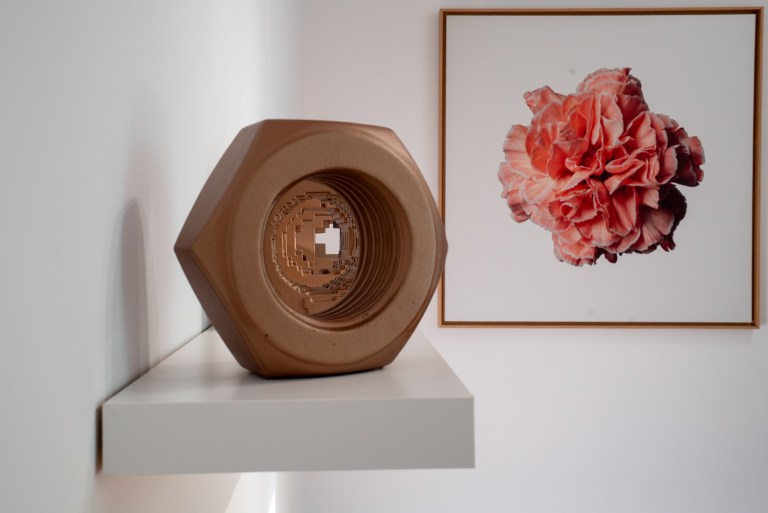
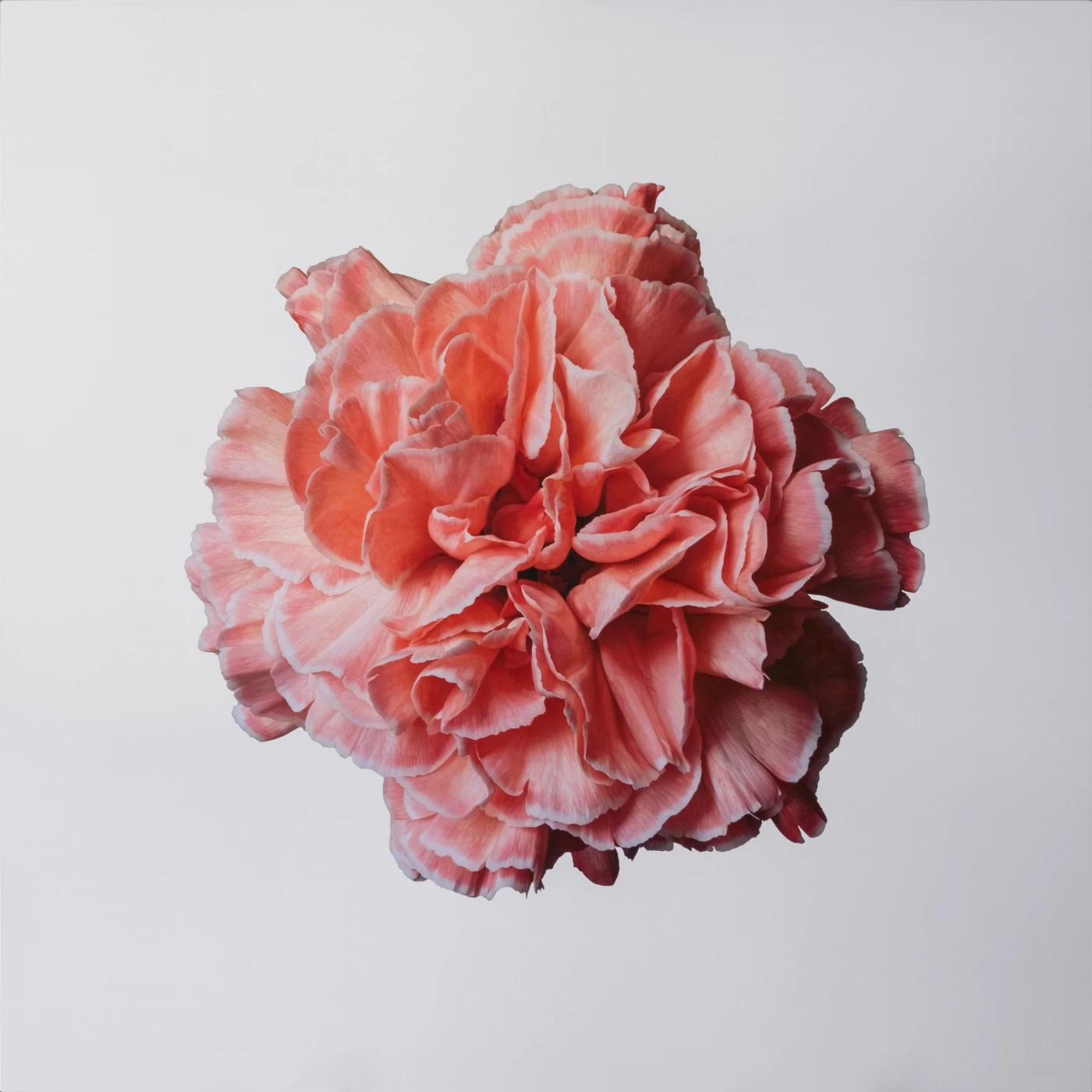
In Blossoming, Celdrán pays tribute to nature and organic beauty in an era dominated by hyper-technology and artificial intelligence. Flowers, beyond their decorative function, are organisms designed for the perpetuation of life, perfect structures that combine attraction and functionality. Their diversity and complexity have captivated humanity throughout history, becoming an integral part of rituals, domestic spaces, and scientific exploration. In this series, the artist proposes a renewed perspective on these natural objects, moving beyond their traditional and ornamental connotations to emphasize their mathematical structure, the harmony of their patterns, and the fragility of their forms. It is an invitation to rediscover their beauty through a fresh and committed gaze.
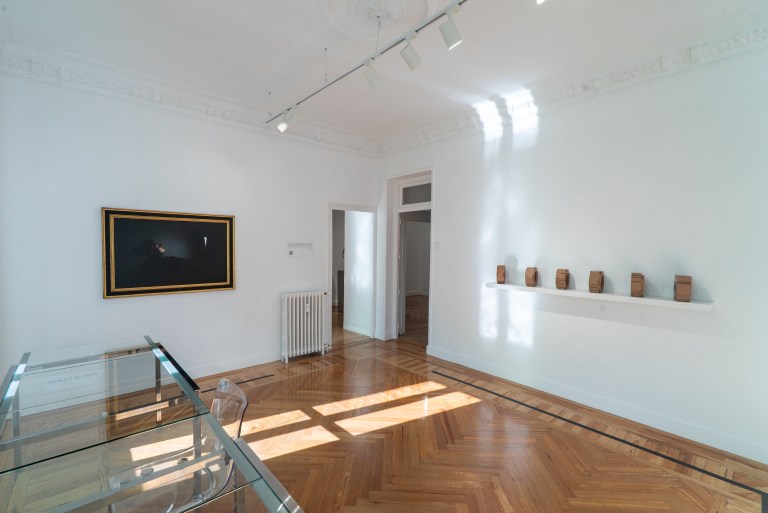
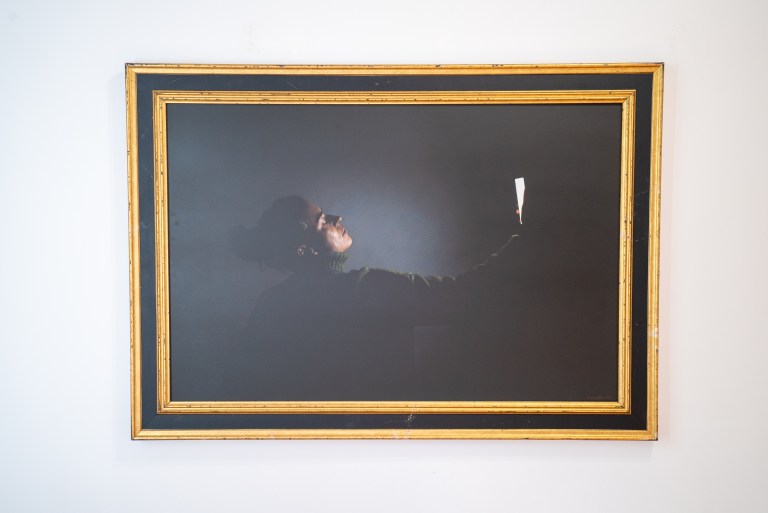
In Digital Tenebrism, Celdrán immerses us in a contemporary reinterpretation of Baroque tenebrism, paying homage to this pictorial tradition and its masters. In these works, the dramatic chiaroscuro that defined Baroque compositions finds an echo in the digital lighting of today. Candles and oil lamps have been replaced by the cold, focused glow of mobile devices, illuminating the faces and hands of figures shrouded in the darkness of their domestic spaces. Through this updated approach, the artist highlights the timeless nature of the human condition, emphasizing how, despite the passage of time and technological advancements, introspection, contemplation, and mystery remain integral to our experience. Beyond superficial changes, Digital Tenebrism reminds us that certain fundamental aspects of human nature persist unchanged across centuries.
From the meticulous observation of nature to the exploration of light and shadow in the digital age, Rómulo Celdrán’s work invites us to reconsider how we see. Blossoming and Digital Tenebrism reveal a duality between the organic and the technological, between permanence and transformation. Both series engage us through their technical precision and conceptual depth, reminding us that art, regardless of its forms and contexts, remains a privileged medium for exploring what defines us as human beings.
The everyday, elevated through form
by Pablo García
Madrid, 2025
Rómulo Celdrán’s work begins from an essential paradox: turning the ordinary into the extraordinary without betraying its essence. Through rigorous technical precision and an analytical gaze at the languages of art, Celdrán builds a visual poetics in which everyday objects—cans, staples, screws, sponges—become protagonists of a broader reflection on perception, value, and memory. In his practice, form is not only a means but also an argument: the how becomes a fundamental part of the why.
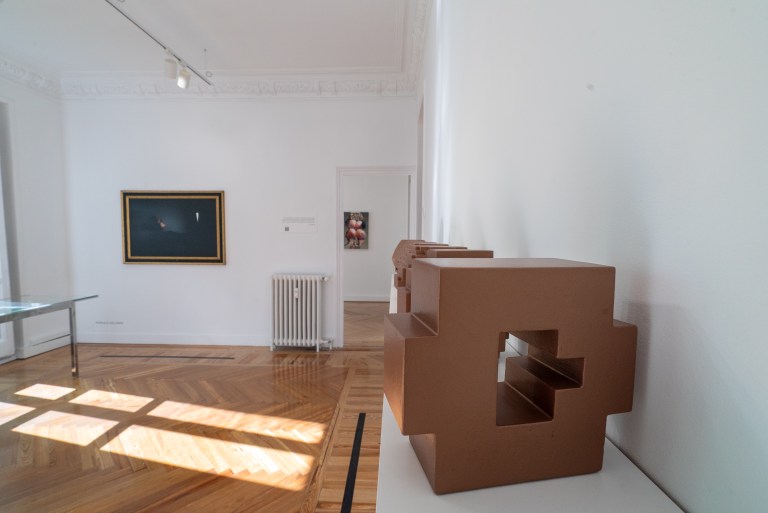
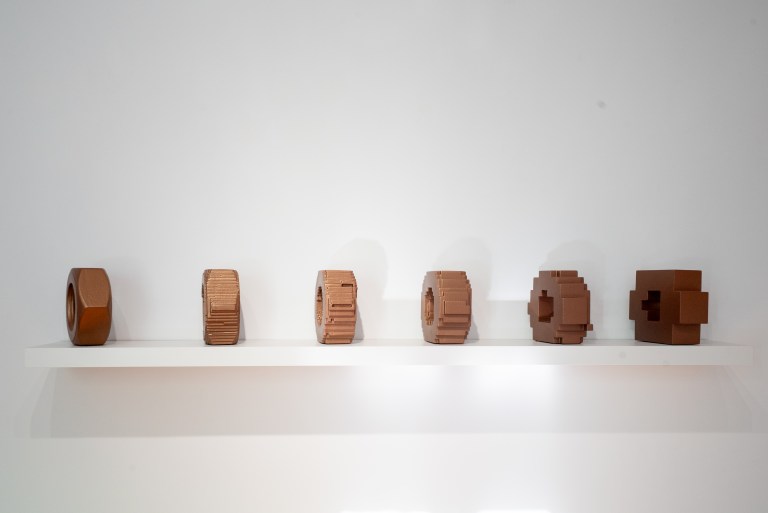
The pieces presented in this exhibition, drawn from different series such as Zoom, Solid, and Digital Tenebrism, share a common concern: to decontextualize recognizable objects and return them, transformed, to the realm of the symbolic. Altered scale, dramatic lighting, meticulous texture—everything is in the service of a slow, almost reverential contemplation that invites us to rethink our relationship to what usually goes unnoticed. In this gesture, the artist activates a politics of attention: to look again in order to look better.
Celdrán’s work situates itself within a complex genealogy that runs from the earliest cave paintings to contemporary hyperrealism, passing through the Flemish obsession with detail, Baroque chiaroscuro, and the conceptual irony of Pop. Yet his proposal is not confined to citation or reference: it articulates a thesis of its own—a critical gaze at the dominant discourse in contemporary art, where the primacy of the idea often eclipses the value of execution. Against this, Celdrán restores to form its capacity to signify.
Each of his works is an act of balance: between the tangible and the illusory, between the object and its representation, between wonder and critique. Set against neutral grounds, volumes are cut with surgical precision, and light—treated almost as matter—confers upon forms a density that verges on the sculptural. But this is not only technical virtuosity: what Celdrán proposes is a reformulation of the essential question of contemporary art—what makes something art?—grounded in the recovery of craft, the sustained gaze, and a commitment to the real.
By elevating the everyday to an aesthetic category, Rómulo Celdrán not only transforms objects; he also transforms the viewer. He compels us to stop, to reconsider, to bestow value. In a time marked by visual vertigo and the proliferation of disposable images, his work calls for a pause. And in that pause, the minimal becomes maximal, the banal reveals itself as profound. There is no discourse without form, he seems to say. And in his hands, form says it all.