MATTER AND MIMESIS
Rómulo Celdrán
DATES & LOCATION
September 2023 – March 2024
S Gallery Madrid
c/ Ferraz 78, 28008 Madrid
ABOUT THE EXHIBITION
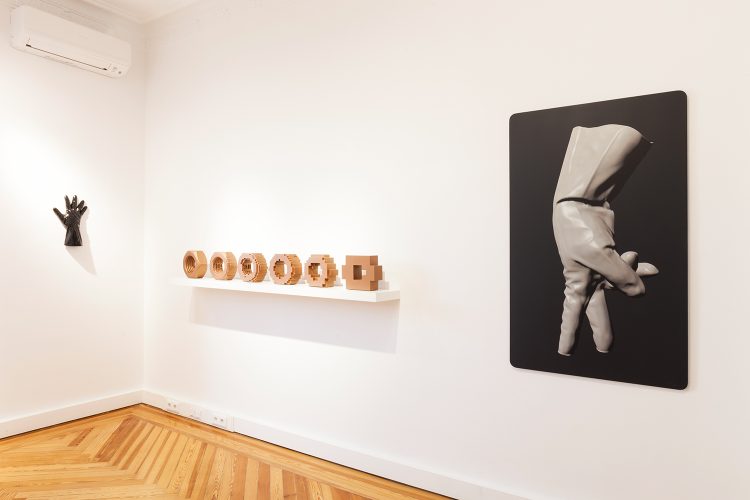
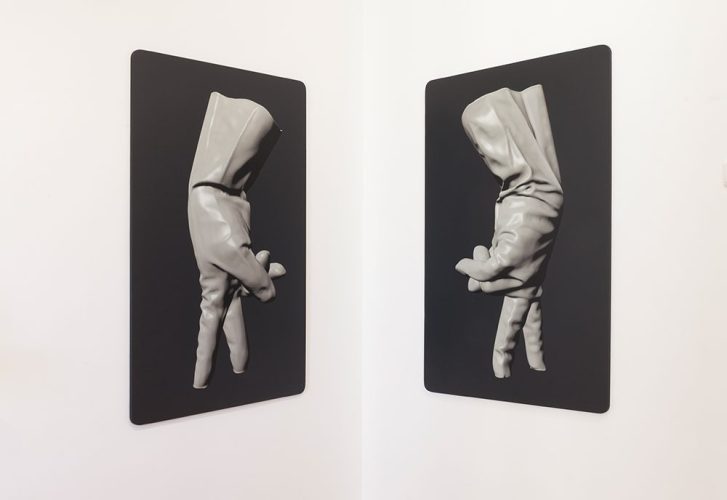
This exhibition presented a selection of early and mid-career works by Rómulo Celdrán, encompassing painting, graphite drawing, and sculpture—three mediums through which the artist explores illusion, perception, and technical mastery.
From hyperrealist drawings of urban interiors to stone and wood sculptures that mimic everyday objects with unsettling precision, the show revealed Celdrán’s ongoing investigation into the limits of materiality and representation. Rather than a display of virtuosity alone, his work invites surprise, irony, and quiet reflection on the nature of art and its capacity to deceive the eye while engaging the mind.


FEATURED ARTWORKS


ABOUT THE ARTIST
RÓMULO CELDRÁN
Rómulo Celdrán crafts hyperrealist works that magnify and decontextualize everyday objects. With references from Flemish masters to Pop art, his pieces blend classical technique with reflections on digital culture and perception.
CURATORS' COMMENTARY
by Julio César Abad Vidal
Talking about the work of Rómulo Celdrán (Las Palmas de Gran Canaria, 1973) is to speak of that of someone who possesses skills, intelligence, and sensitivity that belong to a very different space from that which characterizes much of the production of young people, exhibitionist, confrontational, arbitrary, and eager. Rómulo Celdrán achieves with the same simplicity with which he conducts himself a triumphant apotheosis of his craft and has created a personal proposal that contributes to a heartfelt reflection on the nature of art and its illusion.
Rómulo Celdrán works diligently and disciplinedly, but his production is, even despite his long years of dedication, scarce. Many of his works, although not exclusively, take him several months of work. It cannot, in his case, be otherwise. Until now, he has developed his production through various technical procedures: painting, drawing, lithographic printmaking (although less frequently), and sculpture. Rómulo Celdrán’s primary activity was directed towards painting, in which he has achieved extraordinary results in naturalism in subjects belonging to the genre of still life, which are now very rare to see in cities, such as hares and rabbits dead without skin and hung before their preparation as food. Created between 1997 and 1998, they are still exercises in which he could not yet provide another content other than virtuoso execution, which may justify his assertion that he no longer identifies with them.
In drawing, Rómulo Celdrán directs his gaze towards a certain documentary style of the suburb whose contrasts and sharpness refer the viewer (even though the artist then did not know this reference) to the memory of a black-and-white photographic practice typical of, for example, the highly influential team formed by the German couple Bernd and Hilla Becher, in their registration of the architectural typologies of the contemporary industrial landscape. Even from a short distance, the viewer who knows that it is a graphite drawing on paper or on board, and not a photograph, cannot help but doubt its authenticity. We have even tested this among artist friends, and their eyes have always been deceived. Above these lines, by way of example, a sample of this series of works is offered (Inside I. 2005, pencil on board, 125 x 85 cm).
But perhaps it is in the sculptural medium where Rómulo Celdrán has achieved his most striking works. His experience and mastery as a painter serve him to hit the chromatism that he prints on those sculptures, while the extraordinary deployment of doubt about the material nature that the viewer undergoes when admiring his drawings has also been achieved in the three-dimensional field. Rómulo Celdrán’s sculptures are carved or sculpted from a single block, respectively, of wood or stone. These present two elements: a support that functions, in most cases, as a pedestal and that explains the nature of the material in which they subsist (a block of stone, a trunk, etc.) and, secondly, objects of everyday life that are represented with millimetric literalness and in life size. All these works are precisely titled, Objects, followed by a number that catalogs their chronological order of execution. The astonishing effect is achieved by confusing the viewer who believes to see works of material appropriation of real objects (as occurs in the window-dressing practices of a Jeff Koons or a Haim Steinbach), when in reality they are representations whose almost intolerable repetition, more than amazement, produces a complicit and enthusiastic admiration, sometimes even ironic.
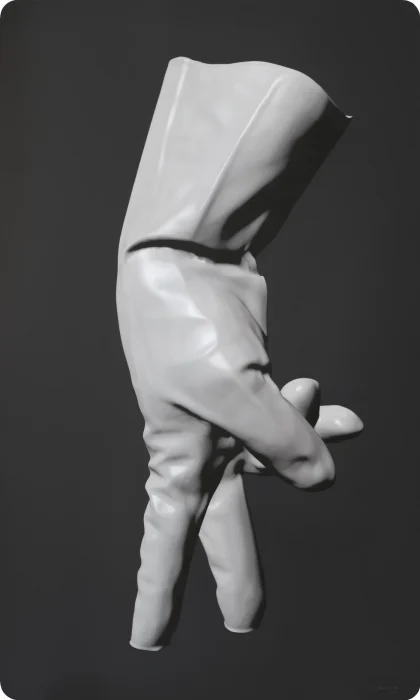
Rómulo Celdrán rejects dogmatism and shows himself confident in his certainty that what he feels called to as an artist is the search for the ability to unfold surprise in the viewer of his works. Without surrendering to mere virtuosity and without ceasing to seek new expressive technical possibilities (currently experimenting with white pencil drawing on black gesso on board), Rómulo Celdrán has acquired a mastery that seemed buried by the debris among which this creator manages to find instruments of affirmation and prodigious companions.