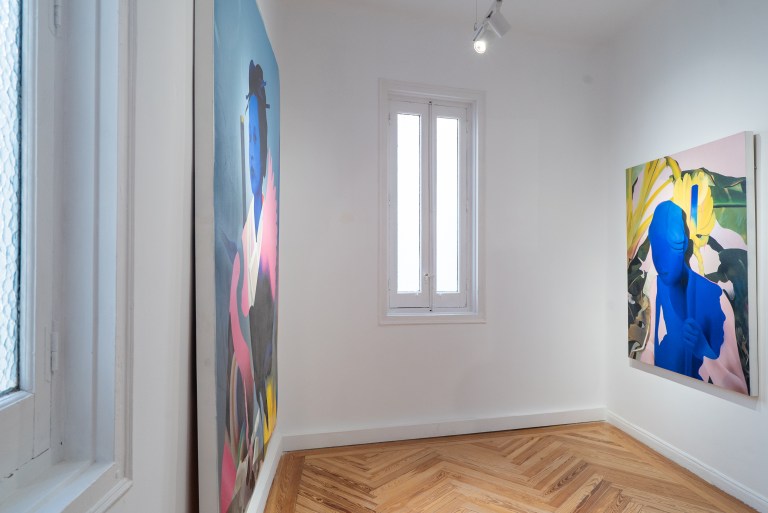
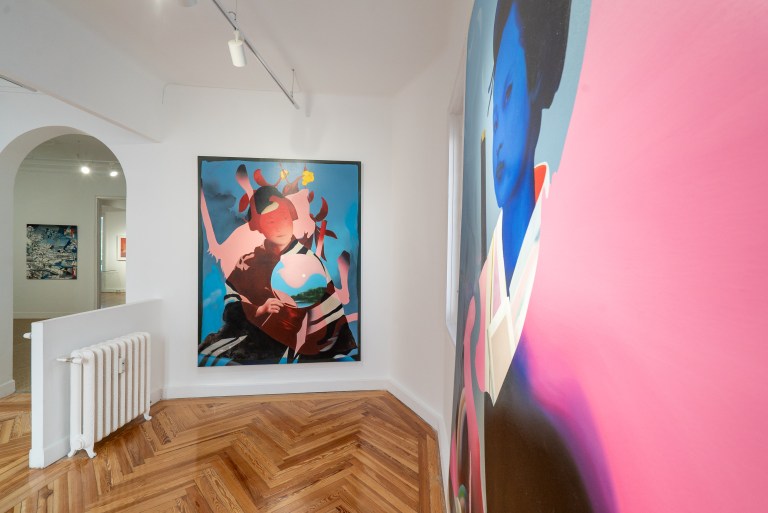
Starting from urban art, Manu Muñoz has developed a free and personal language where chaos and nature coexist. His recent work focuses on stripping elements of their meaning to reorganize them into compositions where chance and order interact without hierarchy, turning the timeless into a compositional core.
FEATURED ARTWORKS
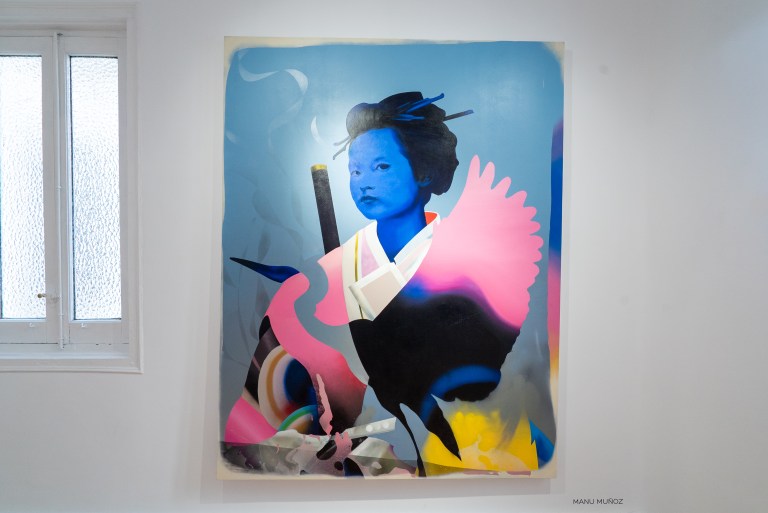
The Young Paco Hassan
Endangered mithological being
ABOUT THE ARTIST
MANU MUÑOZ
Manu Muñoz creates symbolic compositions of spiritual and archaeological resonance. Combining minimalist forms with ancestral references, his works transform simple elements into powerful, contemplative imagery.
Manu Muñoz’s work unfolds as a visual archaeology of the natural world—an excavation in which the animal, vegetal, and human converge in compositions charged with spiritual intensity. From his beginnings in urban muralism to his establishment as a studio artist, Muñoz has developed a visual language that, through formal precision and a rigorous economy of means, transforms landscape into symbol and the ancestral into a contemporary horizon.
In this exhibition, his pieces function as thresholds: entry points to a world where order emerges from chaos and geometry coexists with intuition. Nature—stripped of literal depiction—appears as a web of signs, a constellation of forms that evoke both the mythological and the organic. Representation gives way to evocation. His elements do not describe the external world but reorganize it through a deeply personal imaginary, where each figure becomes a totem, a remnant, a guide.
Muñoz’s compositional control reveals itself in his restrained palette, the precise use of texture, and spatial structure. Nothing is excessive, nothing arbitrary. His painting—whether on canvas, in drawing, or in assemblage—becomes an artifact of contemplation, a silent mirror for our most primal emotions. Far from stridency, his work inhabits the in-between: a place where symbols do not impose meaning but rather suggest it.
Detached from trends or directives, Muñoz’s vision constructs a poetics that celebrates ambiguity as a path to knowledge. His work does not impose answers—it poses visual questions. What remains when an image is freed from the literal? What memory is triggered by a decontextualized symbol? How do we see a landscape that, by its very familiarity, has become invisible? In the worlds of Manu Muñoz, nature reappears not as representation but as an active metaphor for the uncertain, the sacred, and the still unsaid.