(UN)VEILING AND FLYING IN THE LANDSCAPE OF PAINTING
Ikella Alonso
DATES & LOCATION
September 2024 – March 2025
S Gallery Madrid
c/ Ferraz 78, 28008 Madrid
ABOUT THE EXHIBITION
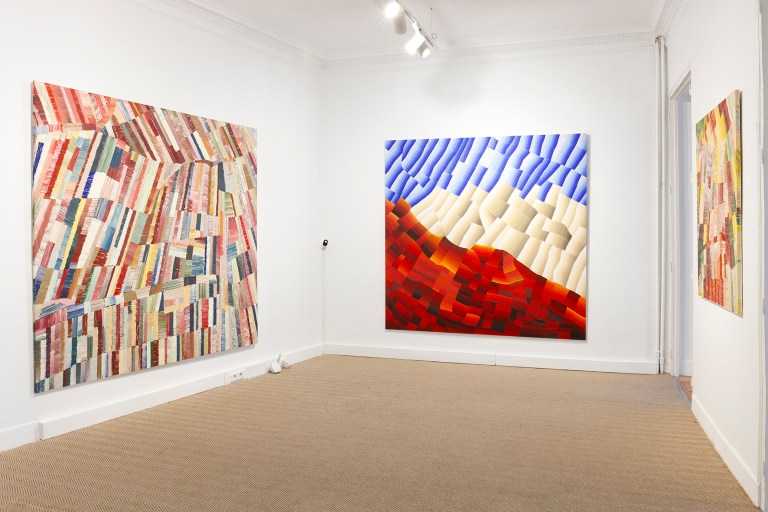
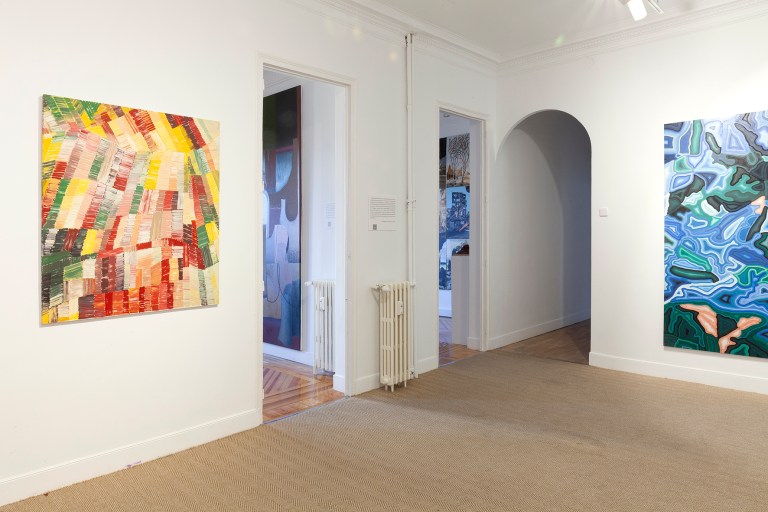
Ikella Alonso weaves abstraction, cartography, and art history into intricate visual topographies that are at once rooted and transcendent. Inspired by aerial views of cities tied to the great masters, his paintings map imagined landscapes where geometry, color, and memory converge. Drawing from minimalist rigor, lyrical abstraction, and a deep engagement with the legacy of painting—from Rothko to Fra Angelico—Alonso creates layered works that reflect a desire to navigate both the mythic and material. His pieces evoke a meditative drift through art’s labyrinth, inviting viewers to trace hidden connections between space, image, and time.

FEATURED ARTWORKS


ABOUT THE ARTIST
IKELLA ALONSO
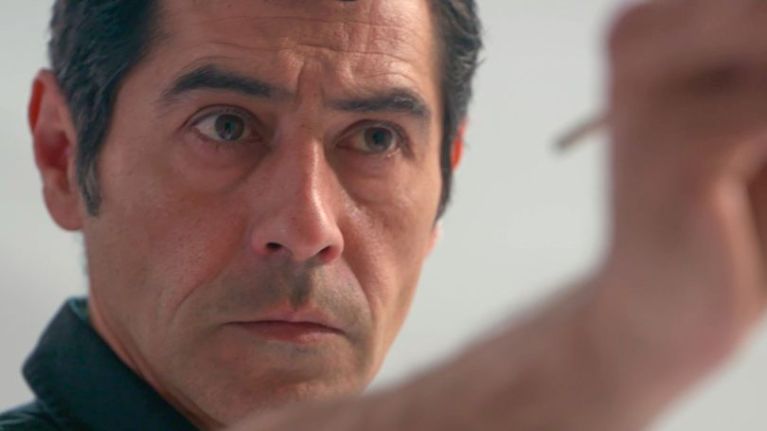
Madrid-based artist whose work merges aerial cartography and art history. Through vibrant, textured homages to masters like Van Gogh and Mondrian, he reimagines painting as a dialogue between geography, memory, and modern abstraction.
CURATORS' COMMENTARY
An approach to the singular cartography of Ikella Alonso
by Fernando Castro Flórez
2024
“I believe,” states John Berger, “that one looks at paintings in the hope of discovering a secret. Not a secret about art, but about life. And if one discovers it, it will remain a secret because, after all, it cannot be translated into words. With words, all one can do is sketch a rough map, by hand, to reach the secret.”
Abstract expressionism, as Robert Rosenblum pointed out, expanded the abyssal experience of romanticism to place us on a “different” uninhabited shore, where we cannot even enjoy the spectacle of an imminent shipwreck as mere spectators. The strength of Rothko’s paintings seems to lie in the fact that they are no longer “paintings” nor merely objects of contemplation regarded as representations of something; instead, they become part of the space in which I find myself, so that, in a way, I am inside the painting itself, integrated into it much like Friedrich’s monk. But it wasn’t just about rethinking the unsettling position of the subject, who sinks into a sublime feeling, but about understanding the accidental nature of painting, the material and gestural dynamic that could occur, in line with Greenberg’s ideology of painterly painting, on a surface stretched taut like a drumskin. “At a certain moment,” Umberto Eco notes, “painting, having fulfilled the parabola of geometric abstract art, also attempts, by other means, the adventure of chance: the randomness with which color drips onto the canvas, the randomness with which the matter, made visible, offers textures to explore, the randomness of peeled floors and walls, of woods and sackcloth, the randomness of plaster smears on sidewalks or walls.”
The Greenbergian criterion for painting (self-criticism, self-definition, and self-reference) was radicalized or, more precisely, taken literally by minimalism, which Greenberg himself did not accept, considering it an entry into the realm of an absurd non-art. “Minimalist artists subverted modern theory, which at the time Greenberg’s followers were adeptly expounding, by the simple act of taking it at face value. Modern art dealt with its own structures, so the minimalists made objects without any references beyond their own making. This absurd extremism worked because it dramatized the situation while recovering a sense of distance that once again allowed for critical discourse.”
In his own way, Ikella Alonso takes up painting, as Marcelin Pleynet proposed, from its zero degree. According to Lyotard, what we should do is transform the energy put into play in what is called painting, not into a kind of liquefaction or a random production. Indeed, it is not Desire (with a capital “D”) that “paints,” but rather a process in which the body and the surface engage until they form a dance. It is the connection between the signifier and the signified, in accordance with Lacan’s theories, that enables the ellipsis by which the signifier installs the lack of being in the relation to the object, using the value of signification’s referral to transform the supporting lack into living desire. “Torn from its split between signifier/signified, reading,” writes Pleynet, “enters into a dance, its disappointed hopes in what its cultural code promised, a dance in which it, upon letting itself be caught in its first step, must already recognize in the next gesture the game it will no longer abandon and will sweep away.” We must keep in mind that in the processes of “minimalization,” to some extent modulated in Ikella Alonso’s imagination, a mise en abyme of the imaginary is produced, and simultaneously, a crystallization of the artistic process that goes beyond the reticular discipline. These minimalist formalizations could be linked to the descriptive-cartographic obsession developed in the Netherlands during the 17th century. Minimalist compulsion becomes fixed in a non-directional art, without cardinal points, in a map that, in a Borgesian manner, never ends up coinciding with the territory. It is, certainly, the intertwining of cartography and the history of painting that shapes the peculiar “landscape” of Ikella Alonso, who installs his works on the floor to emphasize their “vertical perspectives,” proposing a drift that takes up Pollock’s horizontality of dripping without succumbing to archetypal gesturalism.
To reflect on Ikella Alonso’s painting implies moving beyond the clichéd discourse that opposes abstraction and figuration, a dilemma this artist consciously left behind long ago. “It will still be necessary to repeat this for a long time: ‘Remember that a painting—before being a battle horse, a naked woman, or any other anecdote—is essentially a flat surface covered with colors arranged in a certain order.’ Thruth is, painters of all times knew this, though Maurice Denis had the merit of wording it clearly in 1890. This didn’t prevent an academic debate between abstraction and figuration, which has resurfaced frequently since then, in the name of an ideology or aesthetic that excites journalists and professional charlatans.” Without a doubt, one of the attractions of Ikella Alonso’s painting is its ability to situate itself in a territory that is both abstract and endowed with figurativeness. There is no doubt that the abstract in Ikella carries something of an imagined opening, and his geometric processes may refer to architectural questions or allegorize the impulse that led to the construction of cathedrals. When contemplating Ikella Alonso’s works, I think of the fascination and perplexity evoked by looking at Morandi’s paintings, who declared that for him, there is nothing abstract: “In fact, I believe that nothing is more surreal and more abstract than reality.”
We cannot forget the importance of abstraction in the 20th century. To abstract means “to extract something from the whole of which it is a part,” a term derived from the Latin verb trahere, meaning “to pull” or “to drag.” “Put more simply, abstraction is a process by which humans seek generic frameworks instead of specific solutions.” Perhaps the most basic form of abstraction is language, where existing things are translated into words that refer to types of objects rather than describing them one by one. Language is abstract precisely because of its high degree of generality. It is no surprise that the entry for “abstraction” in Diderot and D’Alembert’s Encyclopédie, written by César Chesnéau Dumarsais, analyzes the question in terms of language, as a process of forming a concept by separating it from the sensible reality that stimulated its formation. From the beginning, abstraction in the arts was understood as the act of reducing to the essence or clearing away to arrive at the essence of works of art. In fact, the transition from Impressionist painting to Fauvism and Cubism reflects a gradual process of abstraction in which the representation of reality was simplified, leaving nothing but a composition of colors on a flat surface.
Ikella Alonso’s work can be related to the aesthetics of withdrawal, or in other terms, to what Filiberto Menna described as the analytical option in modern art, a mode of painting that folds back on its essential conditions. Malevich’s idea of walking in the direction marked by the supremacy of pure sensitivity is one of the most important challenges posed by avant-garde poetics, a path in which optical art exploits the fallibility of the eye, posing questions at the limit of perception. In contrast to Malevich’s demand for “forms that have nothing to do with nature,” his desire for the “rupture and violation of cohesion,” Ikella Alonso’s paintings contain traces of “referentiality,” both to the city and to the history of painting itself. Malevich noted on the first page of his small book From Cubism and Futurism to Suprematism: The New Painterly Realism (published in 1915 together with the Last Futurist Exhibition of Painting 0.10), that he had destroyed the ring of the horizon to step “outside the circle of objects.” The black square was the new geometric icon, which also had something of the emblem of “the art of disappearance.” Despite the fascination that Malevich’s “essentialism” might provoke, Ikella is not trapped by his aesthetic of non-objectivism. His chromatic abstractions have a “territorial anchoring,” arising from attention to the birthplace of painting—or rather, of painters—although they also function aesthetically beyond historical-cartographic referentiality.
Miguel Cereceda, commenting on Ikella Alonso’s series The Flight of Icarus, recalled that what is repeated most in Ovid’s narrative are the father’s [Daedalus’] warnings: “Do not stray from the straight line,” as well as the son’s recklessness “driven by the passion of soaring through the sky.” In that myth, cunning ultimately leads to a tragic fall or, in other terms, hubris (the excessiveness that the Delphic oracle tried to curb) is cruelly punished. Certainly, Ikella Alonso does not dwell on the drama of adolescence that risks flying too high nor does he subliminate disaster; on the contrary, he seems to recover the joyful, even dreamlike moment of the “flight,” in a dynamic that, rather than challenging the Sun, returns to the passion of labyrinthine intelligence.
These pictorial constructions by Ikella Alonso have something of hyperbolic ornaments in which mystery beats. According to Alfred Gell, the surfaces of an object come to life when decorative motifs proceed to articulate “an intricate dance to which our eyes are willing to surrender.” The ornaments have no other purpose than to capture attention, but that, as we previously stated, is the Medusa-like desire of images. Ornamentation increases the effectiveness of objects, imposing an aesthetic of difference that reveals, as Deleuze pointed out, a dynamic process of growth of a motif “constituted by zones of variable intensity.”
The “labyrinthine” weavings of these flights represent an extraordinary meditation on landscape and painting. Ikella searches Google Earth for the “aerial landscapes” of the places where the artists he admires were born, turning his work into a fascinating allegory of painting. Thus, for example, the painting titled Urbino (2011) is composed using the layout of the Italian city as a pre-text , with chromatic tones inspired by Raphael’s Transfiguration, or the piece titled Milan (2011), which is also based on the linear layout of that city, hybridized with Caravaggio’s The Entombment of Christ. As Armando Montesinos rightly points out, “painting is venturing into the Daedalus” of art history.
Ikella Alonso contemplates, from the air of art history, the territory in which his imagination must simultaneously root itself and take flight, sometimes playing with a compositional rhythm that, as in Mondrian’s case, curbs the tragic. Despite the funerary mentality (that inertia that leads to “a certain apocalyptic tone” in philosophy, history, artistic experience, or social reality), utopian thought has been able to survive premature burials. We have both the memory, in a Freudian sense, of an archaic gratification and the desire for things not to continue as they are, that is, to show that disaster can be avoided. The map (to repeat the Borgesian allusion) is by no means the territory. We need not so much an infallible compass but rather the courage to unfold, as Ikella Alonso does in his painting, inevitably “delinquent” narratives. We have all kinds of enigmas to (un)veil in the labyrinth.
Sometimes the map, as in the case of Vicchio di Mugello, already offers an extraordinary “plot” that, in Ikella Alonso’s imagination, becomes a veil that “reveals” or, better yet, suggests The Annunciation by Fra Angelico. The necessary angel about whom Cacciari wrote so beautifully may have forgotten the transcendental message he had to (re)veal. Perhaps it is enough with his presence, which, in a Rilkean manner, “announces” to us that beauty and the terrible are intertwined. Ikella Alonso’s Flight of Icarus reminds us that approaching the great masters entails great danger but also that one must face this “annunciation” with cunning. It’s not about surrendering to the paralyzing studium (something that could turn the epigone into a plagiarist or a pathetic commentator), but rather the active artistic task activates the details, punctuating, in the sense established by Barthes, the gaze. Pieter Bruegel the Elder “minimizes” the presence of Icarus fallen into the sea to magnify the landscape, while Ikella Alonso territorializes and abstracts the history of painting in a fascinating palimpsest or puzzle.
As Auden wrote, “everything moves away, delightfully, from disaster,” and in this passionate (re)flight of Ikella Alonso’s painting, the passion of a (meticulously) compositional process is (un)veiled, paradoxically uniting the aerial imagination with earthly gravity, historical sediment with singularly recreated event. Ultimately, the Old Masters teach us something more than suffering; they manage to return us to the labyrinthine wanderings, they incite us to create other maps, encouraging us to vitally explore the space of art.