THE LEGACY OF ART, REFRAMED IN THE PRESENT
Ikella Alonso
DATES & LOCATION
September 2025 – November 2025
S Gallery Madrid
c/ Ferraz 78, 28008 Madrid
ABOUT THE EXHIBITION
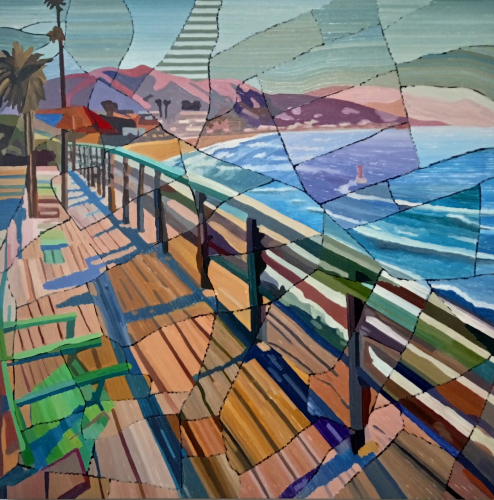
In Other Side (The Bridge), Ikella Alonso reimagines iconic images through aerial, cartographic compositions that act as bridges—between past and present, memory and invention. His paintings blend illusion and emotion, creating new ways of seeing rooted in both art history and personal vision.
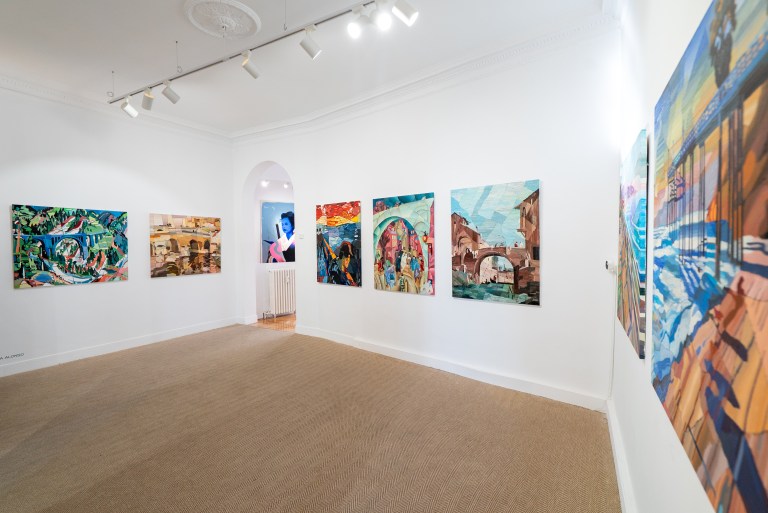


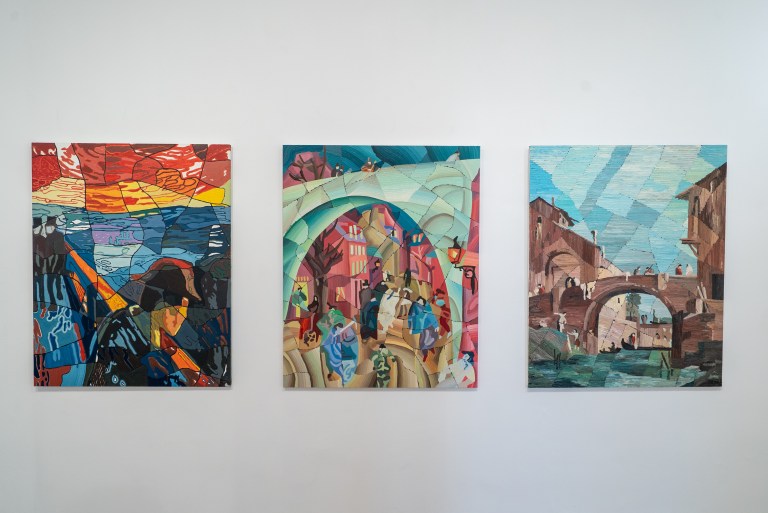
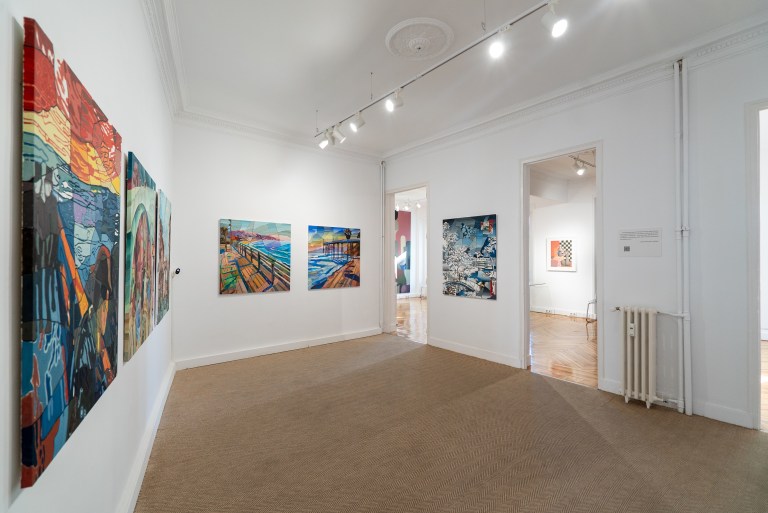

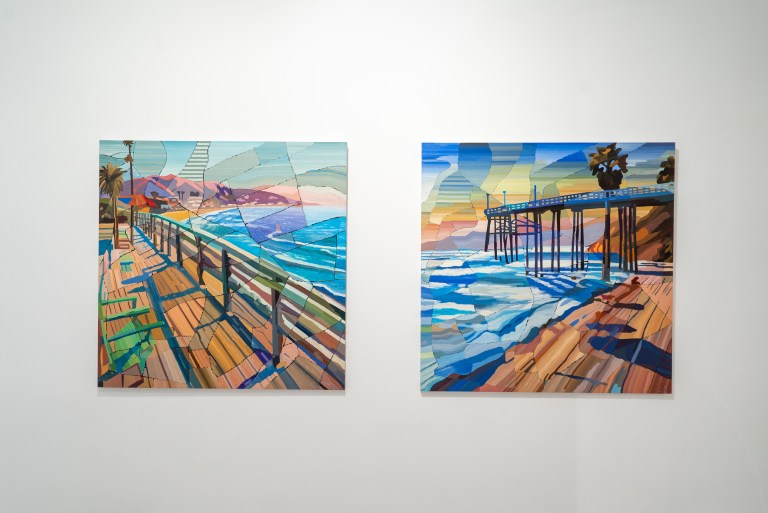

FEATURED ARTWORKS

ABOUT THE ARTIST
IKELLA ALONSO
Madrid-based artist whose work merges aerial cartography and art history. Through vibrant, textured homages to masters like Van Gogh and Mondrian, he reimagines painting as a dialogue between geography, memory, and modern abstraction.
CURATORS' COMMENTARY
Other Side
by Luis Francisco Pérez
Madrid, 2025
In Ikella Alonso’s painting, the practical demonstration of the idea of “perspective” is always presented to us as a complex and highly sophisticated chain of spatial realities. This holds true whether in the enclosed illusionism of Paisajes Interiores (an earlier series, part of which the author viewed in the context of a prison), or in the current series now on view at the gallery, titled Other Side (El Puente). Here, the dual visual and conceptual perspective draws a literal vanishing point, escaping the enclosed poetics of interior space with the aim of positioning the viewpoint (which for the artist is equally a scientific observation point and an emotional one) not in an “exterior” but rather in an exteriority. This bridge does not lead simply to a place (though it may), but to a state of mind or an act of extreme liberation—that which the illusionist demonstration of great painting always demands. In every series created by Ikella Alonso, we are invited to a rare and sensual epiphany of vision, always guided by the unrelenting desire to invent new modes of pictorial expression, particularly when these aesthetic demonstrations belong (though not exclusively) to the rich delta of 20th-century Western painting history.
As a heading rather than a title, Other Side (El Puente) presents an abstract element in its very phrasing—not because it is written in English, but because it frames a location (or a dream, desire, ideal, or fantasy) that lies, in the artist’s words, “on the other side”: something we may or may not know, but prefer to regard as yet unnamed territory. The second part of the title, however, clearly frames the linguistic meaning of the image it presents, as if the abstraction of the prologue could finally be grasped in the semantic architecture of a visually decisive epilogue. More than that: the bridges we see in Ikella Alonso’s work are tools of a creative process that connect artistic and conceptual realities across space and time. They create new territories of meaning capable of conveying—through other voices and domains—the relationship between nature and architecture, between reality and representation, between artistic admiration and the interpretation of that same admiration, between the beloved paintings made by others (Other Side) and the artist’s own creative response. In short, they trace a bridge of recognition and offering. Or rather: they forge a meeting point from passion to passion, through a shared emotion. Beyond that, bridges symbolize connections between two points, whether physical or symbolic. They can represent the union of cultures, people, or ideas. Ultimately, this is always about a shift in perspective that, paradoxically, can only occur once new perspectives have been drawn to enable the transformation.
In these admirable paintings, we certainly see bridges, but also landscapes, since the walkway is set in a broader scene. In a brief note Ikella sent prior to the writing of this text, he explained: “It’s about picking up an image where someone else left it (iconotropy) and carrying it to a new conception of landscape through my own way of seeing (the bird’s-eye view).” I completely agree with the artist’s perspective, but I would add that the true power of these paintings (these images) lies not so much in visually recognizing their origin (Munch, Van Gogh, Sorolla…), but in the language that emerges when those realities (created by Ikella) demonstrate their capacity to stir what belongs to the History of Art. It is in their relation to other visual realities, in the evocative function of their “stamp” (triggering personal and private memory), and in their confrontation with similar or disparate figurations, that a new artistic/pictorial language emerges—one unknown prior to that sequence or rare syntax of perceptions—as a powerful tool of knowledge and re-cognition. That is what these magnificent paintings by Ikella Alonso are about.