INTERIOR LANDSCAPES
Ikella Alonso
DATES & LOCATION
September 2023 – March 2024
S Gallery Madrid
c/ Ferraz 78, 28008 Madrid
ABOUT THE EXHIBITION
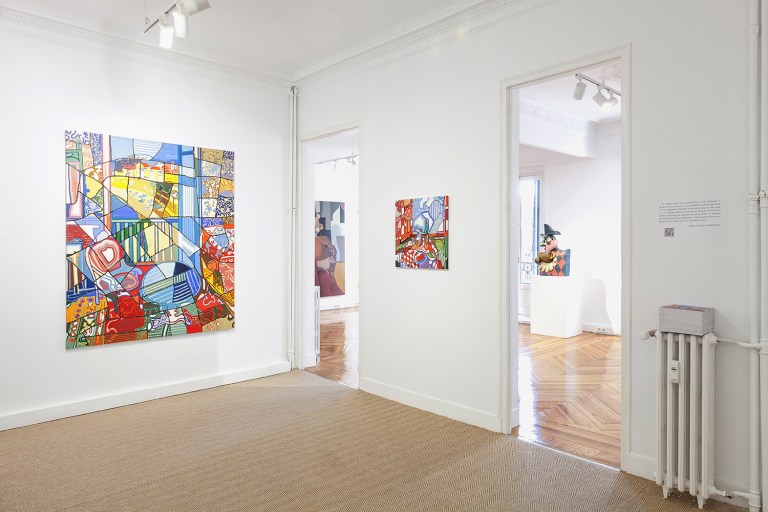
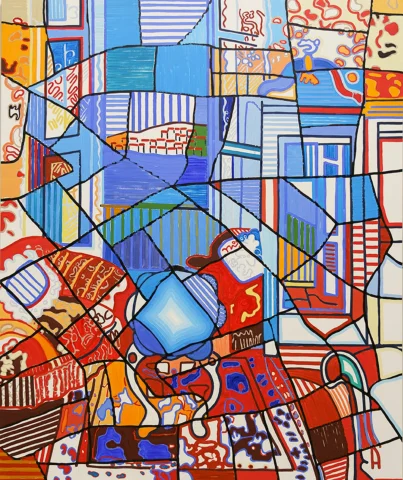
In this homage to Matisse, Ikella Alonso shifts from the aerial logic of the map to a vertical composition—transforming the plan into an elevation. Drawing from satellite views of Le Cateau-Cambrésis, Matisse’s birthplace, Alonso evokes not just geography but memory, conjuring fractured reflections that recall windows opening toward the sea. These works suggest a poetic reawakening of painting: from blueprint to vision, from distance to intimacy.

FEATURED ARTWORKS

ABOUT THE ARTIST
IKELLA ALONSO
Madrid-based artist whose work merges aerial cartography and art history. Through vibrant, textured homages to masters like Van Gogh and Mondrian, he reimagines painting as a dialogue between geography, memory, and modern abstraction.
CURATORS' COMMENTARY
Reflection on the History of Painting
by Miguel Cereceda
Madrid, 2023
Despite their apparent visual complexity, the pictorial devices deployed by Ikella Alonso are relatively simple. His work is built on a threefold reflection on the history of painting and its systems of representation. These three reflections result in three compositional procedures that underpin all of his work.
History of Painting First, Alonso’s research unfolds as a continuous dialogue with the great masters of art history. This dialogue takes the form of series. For instance, he created a long-running series titled Dolce far niente, dedicated to the great masters of Italian painting. Each piece evokes the styles and colors of different painters, from Giotto and Fra Angelico to Mimmo Paladino and Francesco Clemente.
On the occasion of an exhibition at the Spanish-Japanese Cultural Center in Salamanca, he dedicated a new series to the history of Japanese painting titled Landscapes of the Floating World, including homages to masters such as Hokusai and the delicate prints of Hiroshi Yoshida.
In this current exhibition, Alonso engages in a dialogue with French landscape painting, focusing particularly on the Fauvist movement. Here, painters like Henri Matisse, Raoul Dufy, Georges Rouault, and Jean Puy are evoked as prominent representatives of Fauvist colorism.
Cartography Second, the history of painting is also the history of perspectival representation. The core challenge lies in representing a three-dimensional world on a two-dimensional surface. This approach draws from a complex mathematical and geometric intuition, a task tackled by cartography long before landscape painting. Geometry, originating from the need to measure land in ancient Egypt, eventually gave birth to geography and cartography—sciences vital to travel, war, and navigation.
Alonso adopts this cartographic perspective as the foundation for his compositions. Using tools like Google Earth and Google Maps, he locates the birthplace of the artists he pays tribute to and traces the geographic structure of that territory onto the canvas. Each painting is titled after these locations: Le Cateau-Cambrésis for Matisse, Le Havre for Dufy, Paris for Rouault, Roanne for Jean Puy, and so on. He then fills in the resulting segments with brushstrokes inspired by the referenced painters and landscapes.
Perspective Third, painting’s history is deeply rooted in the development of visual perspective. Unlike cartographic perspective, which adopts a top-down view, visual (or linear) perspective presents space from the viewer’s point of view. This system emerged systematically in the 15th century with the studies of Alberti and Leonardo. It is the spatial representation method specific to painting.
In his series Interior Landscapes, Alonso moves from abstract invocations of landscape painting to explicit references to Fauvist interiors. Windows, balconies, chairs, tables, vases, and flowers become discernible—fragmented, as if viewed through a shattered mirror. Thus, domestic interior compositions are superimposed over cartographic land divisions.
This mirror-like view is deeply speculative. Though addressing perspectival systems, the result surprisingly lacks traditional depth. The resulting image is flat or fragmented—a geometric device, a mathematical artifice for trapping painting’s historical legacy.
Color Ultimately, the history of painting is also the history of color. Maurice Denis famously wrote: “A painting—before being a battle horse, a nude woman or some anecdote—is essentially a flat surface covered with colors arranged in a certain order.” Alonso’s Interior Landscapes adhere closely to this idea. Though perspective might be partially disrupted, a refined chromatic arrangement remains.
Initially, the colors seem borrowed from Fauvist paintings, known for their garish, distorted tones. But their arrangement defies rigid methodology, instead enjoying total freedom. Within the grids defined by geography and pictorial logic, color sometimes follows compositional lines, while at other times it asserts its own territory.
The final result of this layered perspectival interplay resembles a kaleidoscope or, better yet, a game of reflections in a broken mirror. As stated from the beginning, Alonso’s work is a triple reflection—not only intellectual but also visual. These series on painting history speculate on the current possibilities of painting, while the mirror-like nature of this speculation remains central to their essence.