VIBRANT MATTER
Alicia Martín
DATES & LOCATION
September 2024 – March 2025
S Gallery Madrid
c/ Ferraz 78, 28008 Madrid
ABOUT THE EXHIBITION
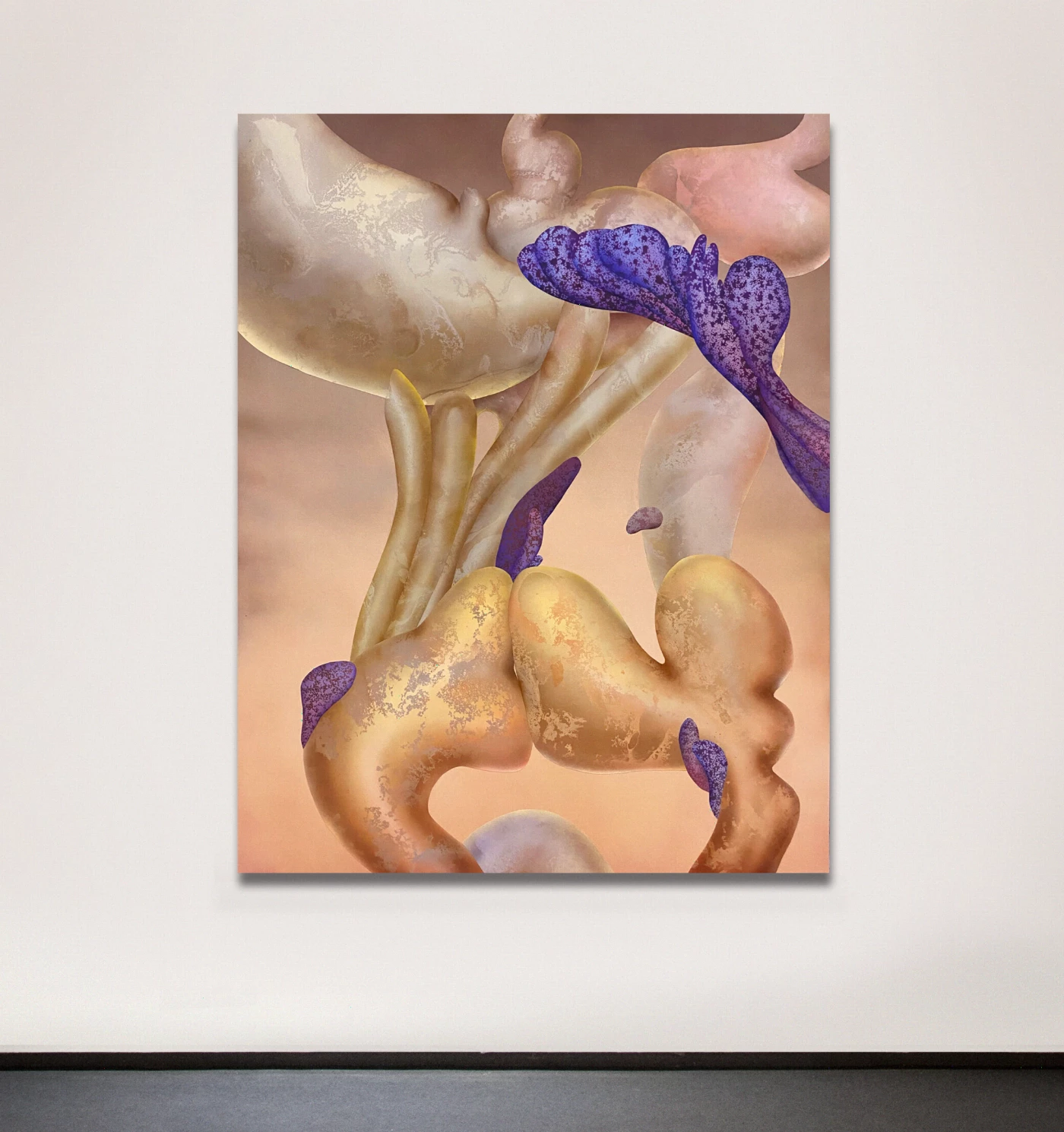
Alicia Martín López explores a redefined abstraction that balances organic unpredictability with structural precision. Working without sketches, she engages directly with the material, producing tactile, otherworldly compositions that feel simultaneously digital and hand-wrought. Her works—often described as sculptural paintings—evoke the birth of form, liminality, and “mattering” as theorized by Karen Barad. In Exactitude and the Void, Martín López invites viewers into a cosmos of folds, textures, and speculative forms that speak to the vitality of matter, the aesthetics of indeterminacy, and the uncanny clarity of abstraction at the edge of the visible.


FEATURED ARTWORKS


ABOUT THE ARTIST
ALICIA MARTÍN
Alicia Martín paints layered, organic abstractions that explore material transformation and natural entropy. Her nuanced compositions play with texture, light, and color to capture ephemeral states and hidden structures.
CURATORS' COMMENTARY
The Vibrant Matter in the Processual Painting of Alicia Martín López
by Fernando Castro Flórez
Zizek has pointed out that among the antagonisms characterizing our era, perhaps a key position belongs to the antagonism between abstraction, which is increasingly determinative in our lives, and the flood of pseudo-concrete images. If we can understand abstraction as the progressive self-discovery of the material bases of art, in a process of singular depictorialization, we also have to comprehend that within this process lies the core of modernity. There is, without a doubt, a considerable fracture between epic modernism (exemplified in painting by American abstract expressionism) and existential nihilist gesturalism (where certain moments of European informalism might be placed) and the new forms of abstraction that emerged after conceptual dematerialization, the phenomenological givenness of minimalism, and, of course, the crisis of the Great Narratives that occurred within the postmodern condition.
We can no longer “legitimize” the practice of painting from Pollock’s drip as a manifestation of energy that must be controlled. Behind the painting, there is nothing else, and certainly no model of vision that resembles Nature. We must consider the (fortunately) precarious situation of painting. Pretending as if nothing had happened is futile. We know that one of the decisive mutations in contemporary painting practice has been the offensive against the modernist canon of purity and autonomy, titanically upheld by Clement Greenberg. Abstraction has been redefined, as lucidly and passionately developed by Alicia Martín López, far removed from lyrical approaches, self-indulgent ornamentalism, or neo-geometric mannerism.
Alicia Martín López sees her painting as a processual investigation in which she works without preliminary sketches, throwing herself, in her own words, into uncertainty, literally “into the void.” She is interested in working from the material itself. Commenting on her works on polyester, she notes that this “support” allows for great versatility and, even when subjected to “abuse,” can achieve a great richness of nuances. In her procedures, it is crucial to act quickly, taking the drying times of the pictorial material into account. For this creator, “it’s as if the painting were alive,” and indeed, what we observe gives the impression of being organic.
Certainly, Alicia Martín López does not attempt, in any sense, to imitate nature, and her aesthetic departs from academic realism. She insists on seeking for the painting to behave like an organism, allowing the material to act, but also intervening and “re-folding” in the process. While the materials seem to function autonomously, we cannot lose sight of the fact that this painter controls and modulates the event.
The final result is a very clean image that seems “cyber-digital” when it is completely analog. The shapes, endowed with a strange sensuality, appear to be things “in a nascent state,” germinal elements of a dystopian physis. Alicia Martín López emphasizes that her works have hardly any “human trace,” as if we were witnessing anticipatory visions of a world without us.
She is not interested, in any sense, in the stain for the stain’s sake, nor does she resonate with expressionist gesturalism. Her images, which have something “stony” or even reminiscent of the realm of botany, are simultaneously flat and three-dimensional, painted but with the appearance of the “sculptural.” In this fascinating aesthetic ambivalence, what appears solid also conveys a sense of lightness. Perhaps what Alicia Martín López sediments are clouds, limbos, inframince materialities.
One of this artist’s series is titled Ánima Mundi (2022), a notion that does not have so much a Jungian connotation as it refers to the “mother mass” from which all things originate. In an era of deranged (pseudo)connectivity, Alicia Martín López unfolds in her intense processual-pictorial modulation a connection between things, games of analogies where everything can be the same and, paradoxically, still differentiate itself. She enjoys the evolution and mutation of forms, admiratively observing the life of matter. These imposing plastic processes could be connected with the meditation on “vibrant matter” by Jane Bennett, with those developments of ontology that go beyond the metaphysics of the subject and presence.
A work of art cannot merely be an empty space; it is always full of noise, especially when it aspires to achieve singular exactitude. For Italo Calvino, exactitude means, above all, three things: a well-defined and calculated design of the work, the evocation of sharp, incisive, and memorable images, and the most precise language possible as a lexicon and as a form of expression of the nuances of thought and imagination. We can think that exactitude relates, although paradoxically, to indeterminacy, but also to that mystical conviction that “God is in the details.”
Understanding exactitude might require speaking of the infinite and the cosmos, leading to Flaubertian delirium. Calvino indicates that exactitude is a play of order and disorder, a crystallization that can be determined by what Piaget calls the order of noise: “The universe,” writes Italo Calvino in Six Memos for the Next Millennium, “disintegrates into a cloud of heat, plunges irreversibly into a whirlwind of entropy, but within that irreversible process, zones of order can emerge, portions of existence that tend toward a form, privileged points from which a plan, a perspective, seems perceptible.” To a great extent, exactitude, like the marvelous determination of the Supernatural (2024) in Alicia Martín López’s painting, places depth on the surface, makes the structure visible, turns the skin of the work into a mirror facing itself.
Let us remember that in 1975 Benoît Mandelbrot coined the term fractal (from the Latin fractus, describing a stone broken into irregular pieces) to designate geometries of the non-regular, in which all parts of the object, no matter how small, have the same structure as the whole (among plants, a clear example is cauliflower; in anatomy, the lung). Perhaps the fractal mathematically reintroduces the notion of the infinite; that post-Euclidean model allowed the analysis of the coriaceous, tangled, strange, fine, granular, curly, tortuous, sinuous, branched—concepts that wink at Alicia Martín López’s paintings, which trust more in foldings (post-baroque or Deleuzian) than in the dogma of the modernist architectural angle poem or the (ideal or solipsistic) givenness of the grid.
Contemporary painting (fractured or expanded) falls into the precipice of a “lack of modern legitimation” and must try to survive despite the iconic saturation. It is a matter of thinking about how to continue painting when we spend so much time navigating virtual space, that is, when the perspective window of traditional painting is replaced by the “cataract” of open windows on the computer screen. In the cybernetic realm, we witness a return to pensée sauvage, to concrete and sensual thought. Perhaps taking things at their interface value involves a phenomenological attitude of trust in phenomena.
The painting, with its drastic enunciation, is a thin layer of that mythical vital, pre-subjective, and non-dead substance (the libido as an organ) that Lacan speaks of in The Four Fundamental Concepts of Psychoanalysis. The tectonics of Alicia Martín López’s painting masterfully put into play the fluid and drying dynamics, petrifications, and transience of clouds, activating perceptual processes, contemplating-and-modifying the material event in the manner of Brownian motion.
I find in the abstraction redefined by Alicia Martín López a lucid and playful assumption of the divided subject; that is, the evidence that the “unification of the self” is lacking. In more topological terms: the division of the subject is not the division between one self and another, between two contents, but the division between something and nothing, between the characteristic of identification and the void. “Decentering thus first designates ambiguity, the oscillation between symbolic and imaginary identification—the indecision regarding where my true key lies, in my ‘real’ self or in my external mask, with the possible implications that my symbolic mask may be ‘more real’ than what it hides, the ‘true face’ behind it.”
This does not mean, in any way, that this creator’s work leads to “tearing”; on the contrary, it situates us beyond the binary, understanding the artistic process as intra-action. Perhaps the germinative richness of Alicia Martín López’s works can be linked to what Karen Barad calls “mattering” (an intractively differentiating process of the world, always in progress), making visible an aesthetics of queering. The rare or strange in these post-surreal works are everyday things, in a drift of the uncanny that fascinates us with its folds and arabesques, subtly imposing its non-“delictive” ornamentalism, leaving the sensation of a lightness that turns the abstract into the prodigiously concrete.