10 YEARS. 10 ARTISTS. 10 STORIES.
Alejandro Pasquale
DATES & LOCATION
September 2026 – October 2026
S Gallery Madrid
c/ Ferraz 78, 28008 Madrid
ABOUT THE EXHIBITION
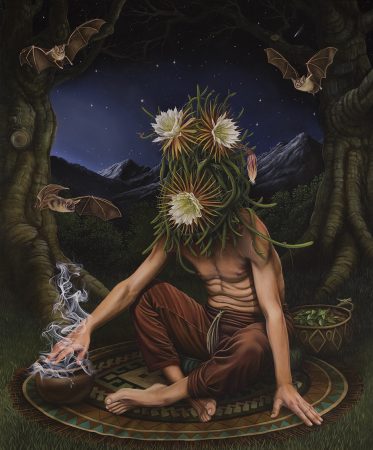
Alejandro Pasquale’s work explores the porous boundary between the human body and the natural world. In his paintings, recognizable figures lose their faces beneath branches, leaves, flowers, and organic forms, creating hybrid anatomies where the human and the vegetal become part of the same living structure.
Through a precise treatment of anatomy, texture, light, and natural tones, Pasquale turns the disappearance of the face into a deeper reflection on identity, consciousness, and belonging. In the context of 10 Years. 10 Artists. 10 Stories, his work reveals that the human body is not a closed frontier, but a space of connection with other forms of life.

FEATURED ARTWORKS

ABOUT THE ARTIST
ALEJANDRO PAQUALE
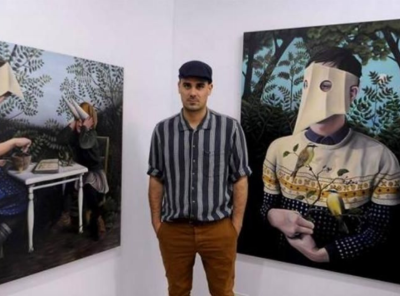
Alejandro Pasquale is an Argentinian artist with a uniquely recognizable style. His work narrates psychedelic states—manifestations of the soul—and visions arising from the exploration of “non-ordinary consciousness.” His art has been exhibited at major art fairs across Latin and North America and is held in the collections of leading contemporary art museums in Argentina.
CURATORS' COMMENTARY
The Continuity of the Living
by Pablo García
Madrid, 2026
Alejandro Pasquale has built much of his career around a question that encompasses both representation and identity: to what extent can the human body be understood as something separate from the rest of the living world?
In his paintings, the figure remains recognisable, yet the face — the traditional site of identity, expression, and individuality — begins to disappear beneath branches, leaves, flowers, fungi, and other organic forms. These are not elements added to the body, nor is this a nature that invades it from the outside. In Alejandro Pasquale’s work, these forms become part of the same anatomy. The human and the vegetal cease to function as opposing categories and instead merge into a single organism.
This operation also transforms the way the image is constructed. By removing the face, Alejandro Pasquale eliminates the primary point of reference through which we usually interpret a human figure. We can no longer rely on a gaze or an expression to determine who stands before us or what emotional state they might be experiencing. Attention shifts instead towards posture, matter, surroundings, and the relationships between different forms. What would ordinarily occupy a secondary position begins to structure our reading of the painting.
Technical precision is essential to making this transformation work. The treatment of anatomy, texture, light, and a palette closely tied to natural tones allows profoundly improbable images to retain a strange sense of coherence. The fusion of body and nature does not occur through a violent rupture, but through a carefully constructed visual continuity. The dreamlike thus emerges not as an exception, but as a possibility seamlessly integrated into pictorial reality.
Throughout his career, Alejandro Pasquale has continued to deepen this relationship. What at first glance might be understood as a physical transformation ultimately opens onto a broader reflection on consciousness, belonging, and the boundaries of individual identity. The body ceases to be a frontier and becomes a place of passage: a surface traversed by other forms of life, other rhythms, and other temporalities.
Nature, consequently, does not function as landscape either. It appears not as something surrounding the figure, but as something of which the figure itself is a part. This reversal shifts the traditional position of the human being within the image: rather than occupying its centre, the human becomes integrated into a broader structure of relationships. Within this gesture lies a critique of the separation between humanity and its environment, but also a more intimate dimension, connected to states of perception and consciousness that extend beyond individual identity.
Alejandro Pasquale’s trajectory can be read through this persistence. Rather than a succession of formal changes, his work develops and complicates the same intuition: that what we understand as identity may be less stable, less autonomous, and less exclusively human than we think.
In 10 Years. 10 Artists. 10 Stories., Alejandro Pasquale thus proposes a different way of making visible what remains hidden. Where we expect to find an individual, a network of relationships emerges. Where we look for a face, we encounter other forms of life. The revelation does not lie behind the figure, but in the possibility of understanding that the human was never entirely separate from that which surrounds it.