THE RESTLESS ORDER
Adrián Guerrero
DATES & LOCATION
May 2026 – August 2026
S Gallery Madrid
c/ Ferraz 78, 28008 Madrid
ABOUT THE EXHIBITION
The Restless Order presents Adrián Guerrero’s painting as a living system where geometry is not stillness, but tension. Drawing from dynamic symmetry, José Clemente Orozco, and broader modernist ideas of structure, Guerrero transforms geometric order into a field of memory, movement, and affect.
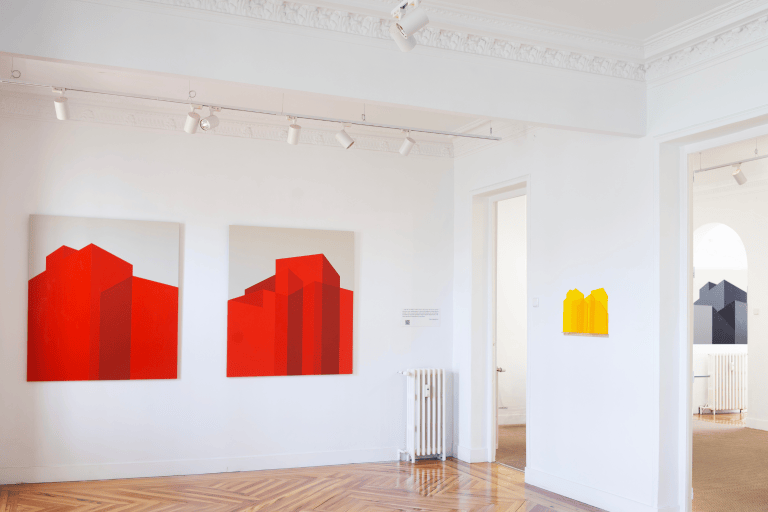
Through the series Dynamic Symmetry and Reacomodos, the exhibition explores how fragments, planes, and spatial relationships can be dismantled and recomposed. The image becomes less a fixed representation than a threshold: a structure that continues to think, shift, and reveal its hidden architectures before the viewer’s gaze.


FEATURED ARTWORKS


ABOUT THE ARTIST
ADRIÁN GUERRERO
Adrián Guerrero is a Mexican artist whose multidisciplinary practice spans photography, video, drawing, sculpture, and painting. Starting from the simple and everyday, his work explores time, spatial relations, and the phenomenology of objects, and has been exhibited internationally across Mexico, the United States, Europe, Singapore, and South Korea.
CURATOR'S COMMENTARY
by Óscar Manrique
Madrid, 2026
The restless order
There is a long tradition—at times overly obedient—that has sought to see in geometry a promise of reconciliation: clarity, measure, stability, repose. As if a well-constructed form could pacify the world. In Adrián Guerrero’s work, that idea does not entirely disappear, but it does acquire a different, deeper density. Geometry remains structure and thought, although in his canvases it no longer presents itself as a language of stillness, but rather as a form of tension, as a thought subjected to the frictions inherent to an organic body. It is not surprising, then, that many of this artist’s investigations lead us to the intellectual and artistic environment linked to the Delphic Studios of New York, where key figures for Guerrero converged, such as Jay Hambidge and José Clemente Orozco, to whom he has devoted much of his research. For the so-called Delphic Circle, composition was understood as a living organization, closer to the rhythms of growth in nature than to a rigid formula. From this perspective, the proportions that structure a work can be read in continuity with certain principles present in the natural world. Hence these ideas have proven so fertile for artists like Guerrero, interested in reconciling modernity with a notion of classical order without falling back into the weight of academicism.
Far from any notion of a concluded order, Guerrero’s paintings activate relationships between matter, space, and time that displace any closed reading. In them resonates Jay Hambidge’s theory of dynamic symmetry, a system that proposes organizing the image through proportions and geometric relationships inspired by classical art. Guerrero arrives at these ideas through the mural work of José Clemente Orozco, and although Orozco does not strictly belong to the tradition of geometric painting, his work reveals a decisive relationship with geometry, understood as the internal structure of composition: the internal scaffolding that sustains the intensity of his scenes, the tension of his bodies, and the dramatic force of his images. Where in Orozco geometry operates as internal architecture, in Adrián Guerrero’s work that skeleton seems to come to light, to be dismantled, fragmented, and set into motion; in both cases, geometry acts as a subterranean energy that organizes the painting from within.
Two series make up this exhibition and, rather than evolving from one to the other, they seem to grow within the same line of thought, as both are part of a continuous investigation. In the series Dynamic Symmetry, the forms seem to play: they are sets of painted segments that attempt to reconstruct the process of memory, to reassemble an image from fragments. Each segment can be viewed in isolation, but something different emerges in its confrontation with the others. From a certain distance, the gaze recomposes the tonality of these parts and generates a new unity, enabling both this decomposition and its opposite: the fragmentary comes back together, and what is part and what is whole ultimately merge in the experience of the painting. While in Dynamic Symmetry this lightness predominates, emphasizing the multiplicity of planes and the internal mobility of the composition, in Reacomodos—a series that takes José Clemente Orozco’s El pueblo mexicano as its starting point—the exploration shifts toward a more spatial construction and a more pronounced scenic sense. The works seem to organize themselves through a more visible architectural will, as if the composition no longer only distributed tensions across the surface but began to build a space, to suggest a habitable, almost theatrical structure. It is not difficult to connect these forms with certain imagined architectures already present in the typical futurist literature of the 1950s, such as those Arthur C. Clarke describes in The City and the Stars: constructions governed by rigorous symmetry and an almost unfathomable complexity, where the clarity of design coexists with a monumental strangeness. In this novel, which has so strongly influenced cinema and other visual arts, the description of the city produces the sensation of a structural intelligence that exceeds the viewer and places them before a form of grandeur that is at once precise and enigmatic. Something of that architectural imagination also resonates in the palette of these works—rather sober—dominated by a range of greys, with the occasional emergence of a red that once again recalls Orozco and that sort of moral temperature of the image that turns the pictorial surface into a field of conflict, making the architectural sensation at times acquire an even more futuristic and spectral dimension.
Bringing this reflection to the other side of the Atlantic, a proximity appears here to certain European approaches of the twentieth century. Aby Warburg, for example, understood images as active survivals, bodies traversed by memories, displacements, and formal returns. No image is born alone; every image carries others, transforms them, and projects them into the future. From this perspective, one also hears the resonance of modern confidence in an internal grammar of form, that will to order that ran through both abstraction and European architecture, from the Bauhaus to De Stijl. In Guerrero, however, this structural vocation does not lead to a cold purity; on the contrary, geometry becomes warm, even tactile, traversed by history, territory, and affect, and responds to a questioning of certain paradigms of painting that go beyond the levels of form.
Thus, the dismantling articulated by Guerrero should not be read in terms of fracture or decomposition, nor even as revision, but rather as an operation of revelation. By isolating fragments, altering hierarchies, and reordering spatial relationships, he makes visible that every image contains others in a latent state. Each element acquires its own breathing, a sensitive autonomy, and at the same time retains the trace of the larger network from which it originates. The work is understood as a device for reading: not so much a place from which to represent a world, but a threshold from which the operations—visible and invisible—that have shaped its construction can be glimpsed. In that tension between fragment and structure, between memory and construction, painting finds a particularly fertile condition: that of never presenting itself as something fully concluded, but as a form that continues to think itself before the gaze.
Óscar Manrique